Sustainable procurement
Basic approach
We conduct fair and equitable procurement activities in order to operate with integrity toward all stakeholders.
We have established a basic procurement policy and our own sustainable procurement guidelines, with the aim of contributing to the realization of a sustainable society throughout the entire supply chain.
Policy
Sustainable procurement guidelines
The environment surrounding companies is becoming more diverse, and in order to achieve sustainable development, it is expected that each company will actively work to fulfill its social responsibility not only through one company, but throughout the entire supply chain. Based on Management Philosophy and Action Mindset, our group has established a basic procurement policy, and through procurement activities based on Integrity ethical standards, we will co-create a "society where sustainable development is possible" with our business partners throughout the supply chain. In order to fulfill this responsibility, we have formulated our own sustainable procurement guidelines based on the international standards ISO26000 (guidance on social responsibility), ISO28001 (supply chain management system), and ISO20400 (guidance on sustainable procurement), as well as the SDGs (Sustainable Development Goals) and the 10 principles of the United Nations Global Compact, from the perspectives of ① organizational governance, ② human rights, ③ labor practices, ④ the environment, ⑤ fair business practices, ⑥ consumer issues, and ⑦ social contribution. We exchange information with our business partners about the status of our sustainability efforts and strive to mutually improve our level.
Governance
In promoting sustainable procurement, the Procurement Department plays a central role and works closely with business partners in accordance with the Sustainable Procurement Guidelines.
Any risks that become apparent are reported to Risk Management and Compliance Committee and Board of Directors, and appropriate measures are taken under an appropriate supervisory system.

Initiatives
Selection of new business partners based on social and environmental standards
At our company, we believe that fulfilling our social responsibility throughout the entire supply chain through collaboration with our business partners is an integral part of our procurement activities. When selecting new business partners, we conduct evaluations in accordance with our "Sustainable Procurement Guidelines," and we only begin doing business with them after they have agreed to the guidelines.
Building a supply chain management system
To fulfill our social mission of ensuring a stable supply of energy and materials, we are committed to building a sound and resilient supply chain.
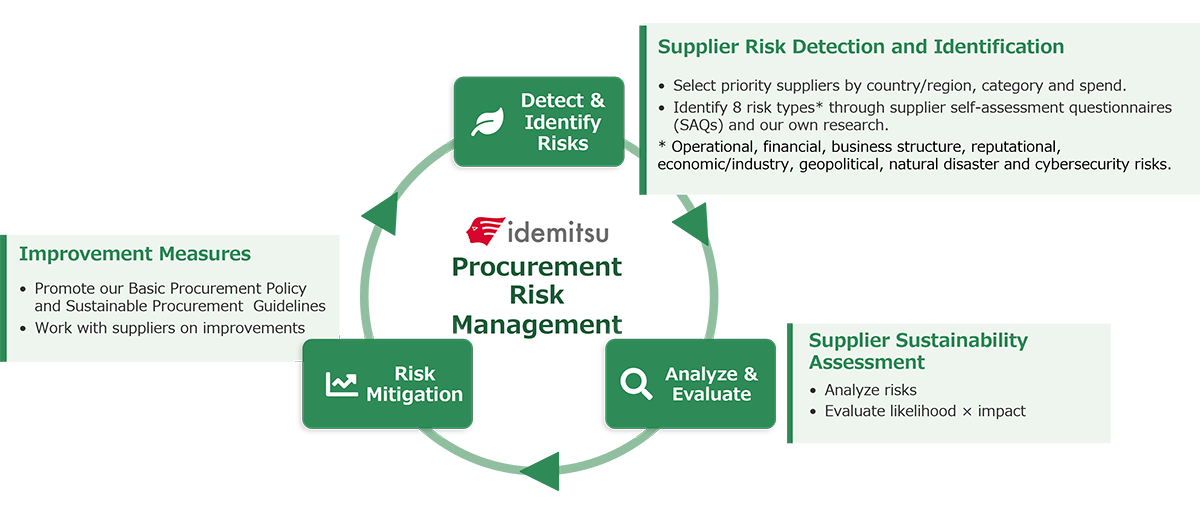
With rising geopolitical risks, disaster preparedness, ESG compliance, and cost increases, the procurement environment is undergoing dramatic changes, making risk management across the entire supply chain essential. Therefore, we have introduced a "Procurement Risk Management System," an evolution of our previous sustainable procurement efforts. This system comprehensively identifies and categorizes all procurement risks that could lead to business disruption into eight types, going beyond just ESG compliance. By regularly conducting processes from risk detection and identification to risk evaluation, analysis, and mitigation, we aim to build a sustainable supply chain.
● Building a sustainable supply chain
Communication with business partners
Early detection of risks is essential for building a healthy and resilient supply chain.
At our company, we believe the key to success lies in "communication based on trust with our business partners." Through frank daily dialogue and information sharing, we aim to prevent problems before they occur and realize a sustainable supply chain.
| FY2025 | Fiscal Year 2026 (Estimate) | Fiscal Year 2027 (Target) | |
|---|---|---|---|
| Total number of business partners with whom communication was conducted (single fiscal year) | 396 companies | 500 companies (104 companies) | 600 companies (100 companies) |