Sustainability policy/promotion system
Basic approach
Under our Management Philosophy of "Truly inspired," our group has set forth two visions: "Your Reliable Partner for a Brighter Future" Vision for 2030 "Shaping Change" Vision for 2050 We are committed to seriously addressing social issues such as energy safety, stable supply, economic efficiency, and environmental compatibility, and fulfilling our responsibility to support people's lives Responsibility to protect the global environment now and in the future. In 2021, with the approval of Board of Directors, we formulated the "Idemitsu Group Sustainability Policy," positioning the promotion of sustainability strategies as one of our important management priorities.
We have identified eight materiality with the aim of achieving both a sustainable society and enhanced corporate value through our business activities.
Policy
Idemitsu Group Sustainability Policy
As a reliable partner, the Idemitsu
Group fulfills the following three responsibilities through its
business activities: "Protect the Environment and Lifestyles," "Support Regional Communities,"
and "Provide for Society with Technological Capabilities." The Idemitsu Group discloses
informat ion appropriately, engages in earnest dialogue and collaboration with stakeholders, and
aims to enhance its corporate value while remaining a sustainable company that observes the
following priority policies.
Environment
・While fulfilling the Idemitsu Group’s crucial social mission of maintaining the stable supply of
energy and materials, we continue striving to realize carbon neutrality, not only within the
Idemitsu Group but also throughout society.
・We promote the development of innovative technolog ies, pursue advance mitigation of
environmental risks in our business activities, and contribute to the conservation of the natural
environment, as well as the realization of a circular economy.
Society
・The Idemitsu Group places the highest priority on respect for human rights in all its decisions
and actions, and strives in its business activities to prevent and ameliorate adverse impacts on
human rights.
・By implementing diversity and inclusion measures, we levera ge our diverse capabilities to
grow as a company and contribute to the realization of inclusive societies.
・Working together with our partners, we contribute to the realization of a sustainable society
throughout the supply chain.
・We make maximum use of our resources to co create solutions that meet the needs of regional
communities.
Governance
・The Idemitsu Group seeks to enhance deliberations by the Board of Directors and continues
to improve its effectiveness.
・We comply with international norms co ncerning the environment, human rights, labor, safety,
and anticorruption.
・We conduct fair and honest management, identify material risks, and implement appropriate
risk management measures.
This policy has been approved by the Board of Directors of Idemitsu Kosan Co., Ltd. Effective: October
Effective: October 19, 2021
Governance
At our company, not only the core ESG issues such as climate change and human rights, but also the various issues of each business are strongly related to sustainability, so we have a system in which all agenda items are discussed by the management committee. The president serves as the chairman of the management committee, and the contents of the discussion are referred to and reported to the board of directors as appropriate.
Additionally, we have established Corporate Sustainability Office within the Corporate Planning Department, which is an organization dedicated to sustainability. Corporate Sustainability Office promotes our company's sustainability management through cross-functional involvement with departments in charge of ESG issues. At least once a year, Corporate Sustainability Office summarizes the progress of sustainability-related issues and reports to the Management Committee.Details are discussed by each responsible department, so that the Management Committee can fully discuss and monitor sustainability issues. That's what I mean.
● Sustainability promotion system
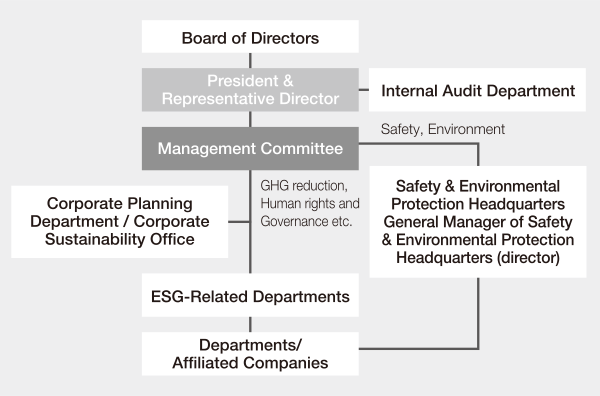
Ensuring the roles and expertise of management
We strive to ensure that Board of Directors and Management Committee have the necessary expertise and experience to appropriately oversee key challenges.
Nomination and Compensation Advisory Committee, composed of independent outside directors, deliberates and submits recommendations to Board of Directors regarding skill matrix that outlines the roles and areas of expertise expected of each director.
Furthermore, for issues in areas requiring a high level of expertise, such as economic security in light of geopolitical risks, we invite external experts to Advisory Board and executive training programs to supplement our knowledge.
Linking executive compensation with sustainability indicators
In the compensation system for directors (excluding non-executive and outside directors) and senior executive officers, performance-linked indicators reflect sustainability-related indicators such as human capital-related indicators and employee engagement.
Integration with internal controls
Our company centrally identifies and manages sustainability-related risks, including climate-related ones, through "Enterprise Risk Management (ERM)."
ERM is operated collaboratively by business units and corporate units. By integrating the identification, assessment, and prioritization of risks and opportunities based on materiality assessments with monitoring by ERM, we aim to integrate it with governance.
Furthermore, Internal Audit Department independently monitors the risk management situation and verifies the effectiveness of internal control functions.
Through these systems, sustainability-related risk management, including climate-related risks, is integrated and operated company-wide, linked to internal control functions via Enterprise Risk Management (ERM). We will continue to enhance the mechanisms that support appropriate governance by management.
Strategy
Our group reviews materiality (key challenges) in line with the formulation cycle of Medium-term Management Plan, from the perspective of medium- to long-term sustainability and enhancement of corporate value.
In our Medium-term Management Plan (FY2026-2030), we have identified eight material issues, organized from the perspectives of business, environment, society, and governance, taking into account changes in the materiality environment and social issues, and we are working to address these issues.
We analyze the risks and opportunities in our business activities regarding these materiality and reflect them in our business strategy and Medium-term Management Plan.
Risk management
Identifying and monitoring sustainability-related risks and opportunities
As a dedicated organization for sustainability, we have established Corporate Sustainability Office within the Corporate Planning Department. We regularly identify sustainability-related risks and opportunities across our group's business segments and value chain, and conduct materiality assessments.
materiality assessments are conducted from the perspective of "double materiality *". For each risk, key challenges are identified based on the following three elements, taking into account future business environment assumptions based on scenario analysis.
(a) Financial impact
(b) Likelihood of occurrence
(c) Short, medium, and long-term time axes
Regarding opportunities, we use the same process as for risks to identify key challenges and reflect them in our management plans and business strategies as appropriate.
In formulating our Medium-term Management Plan, Board of Directors and Management Committee discuss and set sustainability-related indicators and targets as part of the management plan and business strategy. Furthermore, we report to Board of Directors and Management Committee annually on the progress of these indicators and targets.
-
Double materiality
This approach examines the importance of environmental and social issues from both the perspective of their financial impact on a company (financial materiality) and the impact of corporate activities on environmental and social issues (impact materiality).
Relationship with the overall risk management process
Business and corporate divisions collaborate to centrally identify and manage business risks, including sustainability-related risks, based on Enterprise Risk Management (ERM).
In other words, the identification, assessment, and prioritization of sustainability-related risks and opportunities are carried out through materiality assessment, while the continuous monitoring and management of individual risks are carried out through Enterprise Risk Management (ERM). In this respect, both processes are operated in an interconnected manner.
In implementing ERM, we create a "risk report" for each business risk, which systematically organizes anticipated risk factors, scenarios, assessment results, management policies, and monitoring methods. This report is updated annually as a general rule.
For sustainability-related risks, the relevant business and corporate departments prepare "risk reports." The Risk Management Section of the General Affairs Department acts as the secretariat, compiling all reports and submitting them to Risk Management and Compliance Committee and Enterprise Risk Management Committee to ensure company-wide centralized management.