Corporate governance
Directors & Officers
Basic approach
In addition to Vision for 2030 "Your Reliable Partner for a Brighter Future," Idemitsu Kosan formulated Vision for 2050 "Shaping Change" in November 2022, aiming to achieve a carbon-neutral, circular society by 2050. As the global trend toward carbon neutrality accelerates in 2050, it is highly likely that energy systems and social structures will have changed significantly. In the process, many challenges will arise, including discontinuous technological innovation, and there will be a demand for people to deliver new technologies in a form that is acceptable to society.
In response to these social issues and environmental changes, we will fulfill our "responsibility to support people's lives" and "Responsibility to protect the global environment now and in the future" by promoting provide for society based on the knowledge we have cultivated through the stable supply of energy and the relationships of trust with local communities. We will continue to focus on building good relationships with stakeholders, including customers, shareholders, business partners, local communities, and employees, by improving the transparency of our management and striving for healthy and sustainable growth.
The Corporate Governance Code aims to achieve sustainable growth and improve mid- to long-term corporate value through dialogue with shareholders. Our company aims to be "a company that is widely expected and trusted by society," and will fundamentally comply with the Corporate Governance Code.
We will continue to aim for transparent and fair management by frankly discussing the actual state of our management and the environment surrounding it with our independent outside directors and independent outside Audit & Supervisory Board Member who have diverse knowledge and backgrounds and by sincerely incorporating their opinions.
Policy
Governance
Overview of corporate governance system
At our company, the Board of Directors oversees important decision-making, such as business strategies and business plans, and business execution, in accordance with laws, regulations, the Articles of Incorporation, and rules. The Articles of Incorporation stipulate that the chairman of the Board of Directors will be decided by the Board of Directors and that a director other than the President may be selected as chairperson, separating the roles of chairman and president to enhance the objectivity of the Board of Directors. From fiscal 2021, an outside director has served as chairman of the Board of Directors. In addition, to ensure swift decision-making, authority regarding business execution has been delegated to the President, Directors (concurrently Executive Officers), Executive Officers, and General Managers.
Moreover, the execution of duties is audited by Audit & Supervisory Board Members and the Audit & Supervisory Board, which remain independent of the Board of Directors.
●Corporate governance system diagram
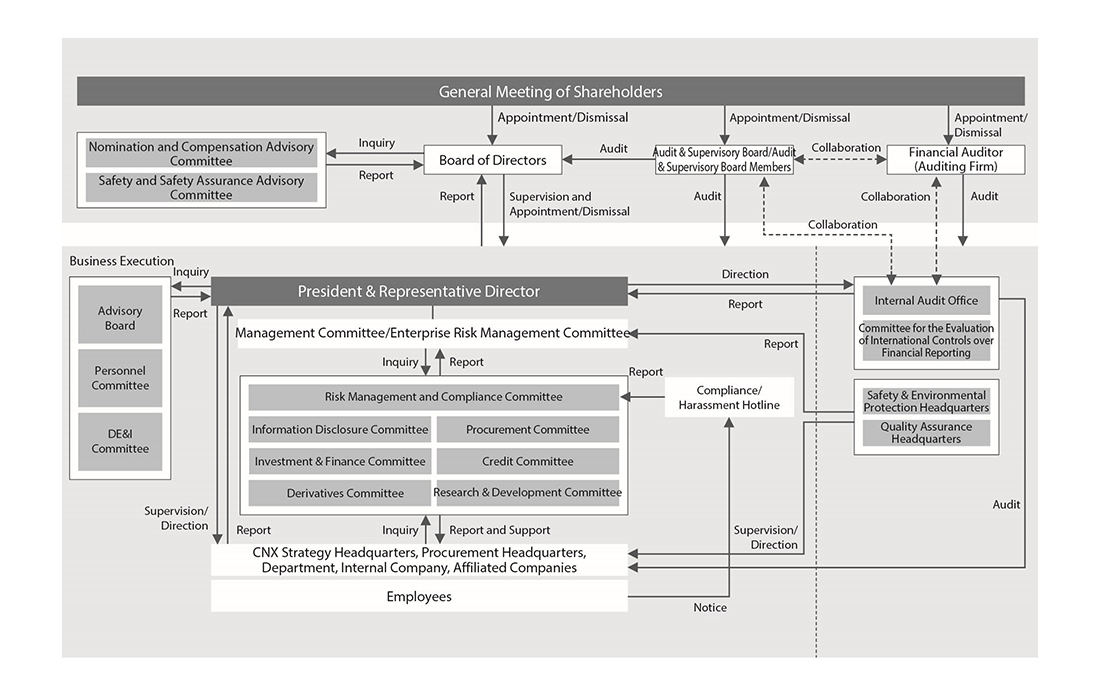
● Composition of Board of Directors and Audit & Supervisory Board (FY2026)
| Fiscal year | Director | Audit & Supervisory Board Member | ||||||
|---|---|---|---|---|---|---|---|---|
| Director | Of which, Outside Director | Percentage of women | Outside Director Ratio |
Audit & Supervisory Board Member | Outside Audit & Supervisory Board Member | Percentage of women | Outside Audit & Supervisory Board Member Ratio |
|
| 2026 | 13 people (10 male, 3 female) |
5 people (2 male, 3 female) |
23.1% | 38.5% | 2 people (1 male, 1 female) |
2 people (1 male, 1 female) |
50% | 50% |
| 2025 | 10 people (8 men, 2 women) |
4 people (2 male, 2 female) |
20% | 40% | 2 people (1 male, 1 female) |
2 people (1 male, 1 female) |
50% | 50% |
| 2024 | 10 people (8 men, 2 women) |
4 people (2 male, 2 female) |
20% | 40% | 2 people (2 male) |
2 people (1 male, 1 female) |
25% | 50% |
Each committee
Nomination and Compensation Advisory Committee
To enhance the transparency and objectivity of functions related to nominations and compensation, we have established a "Nomination and Compensation Advisory Committee," composed of independent outside directors, as an advisory body to Board of Directors. This committee provides recommendations to Board of Directors regarding proposals for the General Meeting of Shareholders concerning the appointment and dismissal of directors and Audit & Supervisory Board Member, the appointment and dismissal of executive officers and their positions, director compensation, and revisions to compensation system.
● Composition and attendance status of Nomination and Compensation Advisory Committee (FY2025)
| position | Full name | Attendance | |
|---|---|---|---|
| Chairperson | Outside Director | Jun Suzuki | 9 times/9 times |
| Outside Director | Takeo Kikkawa | 9 times/9 times | |
| Outside Director | Maki Kado | 1 time/1 time | |
| Outside Director | Shiori Nagata | 9 times/9 times | |
| Outside Director | Mio Kashiwamura | 8 times/8 times |
(Note) 1. The number of times Ms. Maki Nido has attended meetings is listed until her retirement at the conclusion of the 110th Ordinary General Meeting of Shareholders held on June 25, 2025.
(Note) 2. The number of times Ms. Mio Kashiwamura has attended since the day she took office is listed.
●Main deliberations and recommendations (FY2025)
|
|
|---|
|
- Proposed disclosure of skill matrix ・Executive structure for fiscal year 2026 |
|
|
|---|
|
- Setting performance-linked target values for fiscal year 2025 • Action goals for directors Regarding the direction for revising compensation system Regarding the review of compensation system |
Safety and Safety Assurance Advisory Committee
As an advisory body to the Board of Directors, we report on issues to strengthen safety, especially technical issues, in order to prevent large-scale disasters at Refineries/Complexes. Ensuring safety and security and stable supply against recent, increasingly severe natural disasters are becoming increasingly important. Therefore, we select themes and issues based on the latest information and knowledge, and the working group established within the Safety & Environmental Protection Headquarters receives recommendations from experts and implements measures.
Advisory Board
The committee is made up of external experts and serves as an advisory body to the president, providing an opportunity for external experts to offer suggestions on management issues.
Personnel Committee
The Board was established as an advisory body to the President with the objectives of placing the right people in the right positions for executive officers and other positions, achieving fair and impartial evaluations, and enhancing the transparency of the decision-making process. It is made up of the Representative Director and President, Executive Vice Presidents, and officers appointed by the Representative Director and President, and discusses and reports on matters such as the appointment, dismissal, placement, and evaluation of executive officers and the appointment of members of the Management Committee.
DE&I Committee
In order to create an environment where diverse employees can work with enthusiasm and thrive, and to co-create new value, we have established the DE&I Committee as an advisory body to the President. The DE&I Committee is made up of directors as well as a diverse range of executives with different attributes such as gender and occupation, and outside directors also participate as advisors. The committee identifies issues related to DE&I promotion, makes recommendations to management, reports regularly to the Board of Directors, and plans and promotes other company-wide initiatives.
Management Committee, Enterprise Risk Management Committee
We have established the Management Committee and Enterprise Risk Management Committee as forums for discussing and examining management strategies and issues for the entire Group and each executive division. Both committees are chaired by the President and comprise members who emphasize diversity in their fields of expertise and areas of responsibility, and are structured to hold comprehensive and effective discussions on cross-divisional issues and risks.
The Management Committee is a deliberative body that plans and considers strategies related to the Group's management and ensures smooth and proper decision-making on important business operations, while Enterprise Risk Management Committee determines and monitors risk management policies related to the Group's management.
Subordinate to these two committees are committees in each specialized field for the purpose of discussing issues related to business execution and risk management from a more practical and specialized perspective.
●List of each committee
| Committee name | Chairperson | Committee member | Held | Role |
|---|---|---|---|---|
| Management Committee | President | Members appointed by chairperson after deliberation by Personnel Committee | Principle 3 times/month |
Discussion and examination of management strategies and management issues for the entire group and each executive department, and deliberation of business execution |
| Enterprise Risk Management Committee | President | Committee members appointed by chairperson | Principle 2 times/year |
Discussion and consideration of management strategies and management issues for the entire group and each executive department, determination and monitoring of risk management policies |
| Risk Management and Compliance Committee | General affairs officer | Related General Managers | Principle 4 times/year |
Deliberating and formulating important policies for promoting operational risks management, responding to cases of compliance concerns, planning compliance promotion activities, and monitoring the status of activities |
| Information Disclosure Committee | Public Relations Manager | Related General Managers | Held as necessary | Considering and deciding on disclosure of information, etc. |
| Investment & Finance Committee | General Manager of Corporate Planning Department | Related General Managers | Held as necessary | Deliberation and escalation of matters related to investment and financing, and formulation of investment standards, etc. |
| Derivatives Committee | General Affairs Manager | Related General Managers | Held as necessary | Deliberation of derivative transactions, confirmation and reporting of risk management status |
| Procurement Committee | Chief Procurement Officer | Related General Managers | Held as necessary | Deliberation and examination of matters related to estimates and orders for services, construction, materials, etc. |
| Credit Committee | General Affairs Manager | Related General Managers | Principle 1 time/month |
Measures to collect bad debts, etc., and establishment of basic policies regarding debt management, etc. |
| Research & Development Committee | Officer in charge of intellectual property and research | Related General Managers | Principle 4 times/year |
Consideration of matters related to the direction, strategy, and issues of company-wide R&D |
| Personnel committee | President | President and CEO, Vice Presidents, and officers designated by the President and CEO | Held as necessary | Increase transparency, fairness, and impartiality in the decision-making process for the appointment, dismissal, placement, and evaluation of directors, as well as the appointment of members Management Committee |
| DE&I Committee | Vice president | In addition to directors, a diverse range of people with different attributes such as gender and occupation, as well as outside directors who act as advisors, are also involved. | Principle 1 time/month |
Identifying issues related to the promotion of DE&I and making recommendations to management, regularly reporting to Board of Directors, and planning and promoting other company-wide initiatives. |
Risk management
Overview of Board of Directors
In fiscal year 2025, Board of Directors systematically discussed key themes for discussion, including business structure reforms, human resource strategy, evolution of the business platform, and management issues that contribute to enhancing corporate value, in order to achieve Medium-term Management Plan plan covering fiscal years 2023-2025. In addition, in preparation for formulating Medium-term Management Plan (fiscal years 2026-2030), multiple sessions were held after Board of Directors for discussion among all directors and Audit & Supervisory Board Member, where active discussions were held on each theme.
Main topics discussed at Board of Directors (FY2025)
| Key themes | Details of deliberations under the directors |
|---|---|
| Business structure reforms |
In addition to proposals regarding strengthening the profitability of our existing businesses, we also discussed proposals concerning initiatives toward carbon neutrality, investor relations, the general shareholders' meeting, and Shareholder Returns and Dividends. <Major agenda items>
|
| Human capital strategy |
We discussed the status of our DE&I (Developmental Engineering and Integration) promotion activities and our human resource strategy for the next medium-term management plan. <Major agenda items>
|
| Evolution of business platform |
We discussed proposals that will contribute to the evolution of governance that supports our business platform. <Major agenda items>
|
-
The above are some of the items to be discussed. In addition to the above, the committee deliberates on matters stipulated by laws and regulations, articles of incorporation, etc., and makes necessary resolutions.
Outside Directors Meeting
To further enhance discussions at Board of Directors, we held six meetings per year for outside directors, consisting solely of independent outside directors and independent outside Audit & Supervisory Board Member, to exchange information and share understanding on the following topics.
-
Progress of the entire Lithium Battery Material Department
-
Overview and future direction of Advanced materials & Performance Chemicals business
-
About the AgriLife (pesticide) business
-
Current status and future of geothermal projects
-
DX progress
-
Internal Control Initiatives (2024 Review and 2025 Basic Policy)
-
Preliminary report on the 2025 Board of Directors Effectiveness Evaluation and free discussion
Executive Training
In order for our executives to deliberate on the management challenges facing our company, we invite external experts to conduct executive training at least once a year, in principle. In fiscal year 2025, with the aim of deepening our consideration of the measures we should take in light of the current global situation, the situation in Japan, and future environmental changes, we conducted executive training on the impact of the Trump administration's foreign and tariff policies on the world, Japan, and our company, as well as what we should prepare from the perspective of energy security.
Evaluation of the Effectiveness of Board of Directors
It is our policy to have all directors and Audit & Supervisory Board Member evaluate the overall effectiveness of Board of Directors at least once a year and to disclose a summary of the results. We conduct a survey of all directors and Audit & Supervisory Board Member, and strive to review and improve our evaluation processes annually to enhance the effectiveness of Board of Directors. We design the survey questions and analyze the responses with the advice of an external specialized organization.
Through individual interviews conducted by legal counsel with all outside directors, we gather insights into the directors’ perceptions of issues that could not be identified through the questionnaire alone, and use these to identify challenges and discuss initiatives aimed at further enhancing the effectiveness of Board of Directors.In fiscal year 2025, in addition to the traditional survey questions, we held open discussions among outside directors with the aim of fostering more active dialogue to identify issues and consider countermeasures, taking into account the “Board of Directors ’s 5 Principles for Strengthening Profitability.”
Evaluation Results
In response to the issues identified in fiscal year 2024, the following measures were taken in fiscal year 2025.
| Further strengthening of strategic discussions |
|---|
| In formulating our Medium-term Management Plan (FY2026-2030), we discussed the overall strategy and key individual issues at meetings with Board of Directors and outside directors, and also worked on improving operational aspects. |
| Reporting and deliberation on the overall risk management system |
| We increased Board of Directors' involvement in risk management policies and responses, strengthened its oversight function over the operation of the risk management system for all aspects of business, and worked to improve reporting and deliberation on serious accidents and troubles with significant social and financial impacts. |
Based on the effectiveness evaluation for fiscal year 2025, Board of Directors determined that effectiveness was ensured. The challenges identified for further improvement in effectiveness were "further enrichment of strategic discussions" and "improvement of outside directors' understanding of our business." As a result of these discussions, the following specific initiatives will be implemented.
| Further enrichment of strategic discussions |
|---|
| We will further enhance strategic discussions by revising the criteria for submitting proposals to Board of Directors, delegating the execution of individual proposals, formulating a roadmap that includes checking the progress of Medium-term Management Plan (FY2026-2030), and utilizing forums for prior explanations and focused discussions on key issues. |
| Enhancing opportunities for outside directors to improve their understanding of our company's business. |
| In addition to enhancing meetings and intensive discussion forums for outside directors, we will further improve opportunities for outside directors to understand the company by expanding dialogue opportunities between executive officers, General Managers, and outside directors. |
Management monitoring
Our management monitoring system includes supervision by the Board of Directors, audits by Audit & Supervisory Board Member, and accounting audits, as well as internal audits by the Internal Audit Department based on the "Internal Audit Regulations" and internal control evaluations based on the "Internal Control Evaluation Regulations for Financial Reporting."
The Internal Audit Department, which reports directly to the President, regularly audits executive departments from an independent standpoint to check the effectiveness of the self-management that each executive department implements based on company regulations, as well as the progress of risk management and internal control. The results of the audits are reported to the President, Audit & Supervisory Board Member, Executive Officer in Charge, and the General Managers of the relevant executive departments. Executive departments that receive recommendations for improvement during audits prepare improvement implementation plans, submit them to the General Manager of the Internal Audit Department, and make improvements. The Internal Audit Department also conducts follow-up audits as necessary. Annual reviews of internal audits and plans for the next year are regularly reported to full-time directors and general managers of executive departments at the "Management Information Liaison Meeting," and to outside directors and Audit & Supervisory Board Member at the "Outside Officer Meeting."
Audits by Audit & Supervisory Board Members
The four Audit & Supervisory Board Member audit the status of business execution by directors and other executives by attending board meetings and reviewing business reports, financial statements, and consolidated financial statements submitted to the general meeting of shareholders. They also attend important meetings other than board meetings, such as the Management Committee, and conduct daily audits to enhance their effectiveness by meeting with officers, general managers, branch managers, managers of complexes, and presidents and auditors of subsidiaries, and Audit & Supervisory Board Member, as well as on-site inspections of major departments. In principle, meetings are held with the representative director once a quarter to discuss issues and exchange opinions.
● Audit & Supervisory Board Activities (FY2025)
| Item | Implementation status for fiscal year 2025 | |
|---|---|---|
| Audit & Supervisory Board | 15 times/year | Through attending Board of Directors meetings and participating in important meetings, we discussed and considered management issues and risk perceptions. We also shared information on changes in the business environment and the progress of business structure reforms by receiving activity reports from full-time Audit & Supervisory Board Member and information from relevant departments. Furthermore, we deliberated and resolved on important matters based on laws and regulations, such as audit policies and plans, the appropriateness of accounting audits, and audit reports. |
| On-site inspection (On-site hearing) |
6 club rooms 25 affiliated companies (20 of these are overseas companies) 9 cases involving outside Audit & Supervisory Board Member |
We conducted on-site interviews with key departments and affiliated companies both domestically and internationally to confirm the status of business structure reforms and CNX *-related initiatives, as well as changes in the external environment. We also checked the safety, compliance, and quality assurance efforts and equipment response status at the manufacturing sites, and made efforts to understand the actual situation regarding investments in human capital and talent acquisition and development. |
| Meeting with the CEO | 4 times/year (June, September, December, March) |
After sharing our audit policies and key audit items, we exchanged views on the business environment surrounding our company and the direction of business structure reforms. |
| Interviews with executive officers, executive officers, and General Managers | 2 executive officers Two executive officers 11 General Managers |
We individually reviewed the policies and performance of the duties of each person in charge, focusing on areas related to the key audit items. |
-
CNX = Carbon Neutral Transformation
In addition, we have a Group Audit & Supervisory Board Member Meeting for the 13 Audit & Supervisory Board Member who are dispatched to affiliated companies, and we collaborate with the General Affairs Department Management Consulting Group, which dispatches non-executive Audit & Supervisory Board Member to 62 affiliated companies both in Japan and overseas.
Initiatives
Nomination and training of candidates for directors and Audit & Supervisory Board Member
Nomination of candidates for the board of directors
To fulfill the roles and responsibilities of Board of Directors, we believe it is necessary to have a certain number of directors who are thoroughly familiar with our business and challenges. Furthermore, to ensure the independence and objectivity of Board of Directors, it is important to ensure diversity in the knowledge, experience, and abilities of our directors. Based on the above considerations, we utilize talent standards, skill matrix, and other tools to select directors while considering the overall balance.
The president submits a draft proposal, after thoroughly evaluating each candidate's abilities, knowledge, and performance, to the Nomination and Nomination and Compensation Advisory Committee Nomination and Compensation Advisory Committee, and Board of Directors makes a decision based on the committee's recommendations.
Furthermore, the committee will deliberate on the dismissal of directors as necessary and report its findings to Board of Directors.
Nomination of candidates Audit & Supervisory Board Member
Candidates will be selected based on their appropriate experience, skills, and necessary knowledge of finance, accounting, and law. In addition, candidates Audit & Supervisory Board Member will be selected based on their thorough understanding of our business and challenges, and their ability to accurately, fairly, and efficiently conduct audits and supervision of our company. Using talent standards, skill matrix, etc., the president submits each candidate to Nomination and Compensation Advisory Committee, and Board of Directors makes a decision based on Nomination and Compensation Advisory Committee 's recommendations and with the consent of Audit & Supervisory Board.
Developing a succession plan
Nomination and Compensation Advisory Committee deliberates on the selection and development of next-generation executive candidates based on long-term plans and submits its recommendations to Board of Directors. Currently, we are working on the selection and development of candidates, including the succession plan for the president.
Independence standards for outside directors
To ensure that Board of Directors exercises its supervisory function and Audit & Supervisory Board exercises its auditing and supervisory function, we select outside directors who meet the "Independence Criteria for Outside Directors," taking into consideration their diverse knowledge and backgrounds, and who possess the knowledge and experience to provide valuable advice to the management of our company. Our basic policy is that independent outside directors constitute at least one-third of the directors, and independent outside corporate Audit & Supervisory Board Member constitute at least half of Audit & Supervisory Board Member.
Skill matrix
It is extremely important Board of Directors, comprised of directors and Audit & Supervisory Board Member with diverse knowledge and experience, to actively engage in discussions and improve the quality of their debates on overall management strategies, including human resource strategies.
Since creating and disclosing skill matrix in 2020, we have periodically reviewed it in light of the management challenges we face, and have also revised the areas in which we expect our executives to perform their duties. We also pay attention to diversity and appoint executives who possess knowledge and experience in these areas.
To address areas where Board of Directors lacks expertise (such as economic security and other fields requiring a high level of specialization), we supplement this by inviting external experts to Advisory Board and executive training programs.
| Perspective | Expected field | Reasons for selecting it as a promising field |
|---|---|---|
| A perspective that leads to change | Management Philosophy and business strategy | You will be required to have a deep understanding of and put into practice our company's management objectives and raison d'être, and steer management towards realizing Vision for 2050 while also taking into account economic security, SDGs, digital transformation, and other factors in this disruptive business environment. |
| Human resource development/DE&I | The Officers are required to have knowledge and experience in promoting human capital strategy (disseminating the action guidelines, developing transformative talent, and DE&I). | |
| Co-creation/international business | In order to increase provide for society capabilities toward realizing Vision for 2050, it is necessary to build co-creation relationships with a variety of partners, taking into account an international perspective. | |
| Perspectives that support business management | Manufacturing/Research | Knowledge of the safety and environmental aspects of manufacturing, technical knowledge, innovative advanced technology trends, and research areas are required. |
| Sales· | Knowledge of sales, sales, and retail marketing in each business, as well as knowledge of procurement and supply is required. | |
| Governance/Legal | Knowledge of governance from a shareholder perspective, risk management related to business operations, and legal knowledge is required. | |
| Finance/Accounting/Taxation | Knowledge of finance, accounting, and taxation is required to help ensure capital efficiency and profitability. |
●Skill Matrix: Director
| Full name | Tenure period |
Areas in which the Company particularly expects directors | ||||||
|---|---|---|---|---|---|---|---|---|
| Management Philosophy Business Strategy |
Human resource development/ DE&I |
Co-creation/ international business |
Manufacturing/ the study |
Sales· supply |
Governance/ legal affairs |
Financial accounting· Taxation |
||
| Full name | Tenure period |
Areas in which the Company particularly expects directors | ||||||
| Corporate philosophy/ business strategy |
Human capital development/ DE&I |
Co-creation/ international business |
Manufacturing/ research |
Marketing/ supply |
Governance/ legal affairs |
Finance/ accounting/ tax |
||
| Shunichi Kito [Reappointment] |
13 years | ● | ● | ● | ● | |||
| Noriaki Sakai [Reappointment] |
5 years | ● | ● | ● | ● | |||
| Atsuhiko Hirano [Reappointment] |
6 years | ● | ● | ● | ● | |||
| Masahiko Sawa [Reappointment] |
4 years | ● | ● | ● | ● | |||
| Takashi Sakata [New] |
- | ● | ● | ● | ● | |||
| Kazuma Ikeda [New] |
- | ● | ● | ● | ● | |||
| Masakazu Idemitsu [Reappointment] |
7 years | ● | ● | ● | ||||
| Kazunari Kubohara [Reappointment] |
7 years | ● | ● | ● | ||||
| Jun Suzuki [Reappointment] [Outside the Company] [Independent] |
3 years | ● | ● | ● | ● | |||
| Shiori Nagata [Reappointment] [Outside the Company] [Independent] |
2 years | ● | ● | ● | ● | |||
| Mio Kashiwamura [Reappointment] [Outside the Company] [Independent] |
1 year | ● | ● | ● | ● | |||
| Sumiko Takeuchi [New] [Outside the Company] [Independent] |
- | ● | ● | ● | ● | |||
| So Hirano [New] [Outside the Company] [Independent] |
- | ● | ● | ● | ● | |||
●Skill Matrix: Audit & Supervisory Board Member
| Full name | Tenure period |
Areas in which the Company particularly expects directors | ||||||
|---|---|---|---|---|---|---|---|---|
| Management Philosophy Business Strategy |
Human resource development/ DE&I |
Co-creation/ international business |
Manufacturing/ the study |
Sales· supply |
Governance/ legal affairs |
Financial accounting· Taxation |
||
| Full name | Tenure period |
Areas in which the Company particularly expects directors | ||||||
| Corporate philosophy/ business strategy |
Human capital development/ DE&I |
Co-creation/ international business |
Manufacturing/ research |
Marketing/ supply |
Governance/ legal affairs |
Finance/ accounting/ tax |
||
| Nami Kitamura | 1 year | ● | ● | ● | ● | |||
| Yoshitaka Onuma [New] |
- | ● | ● | ● | ||||
| Yumiko Ichige [Outside the Company] [Independent] |
4 years | ● | ● | ● | ||||
| Masahiko Tezuka [Outside the Company] [Independent] |
2 years | ● | ● | ● | ● | |||
-
●indicates areas to which the Company particularly expects the relevant Director or Audit & Supervisory Board Member to contribute and does not represent all of his/her skill and experience.
Training
We provide and arrange training opportunities and cover the costs for training suited to each Director and Audit & Supervisory Board Member including independent outside Directors and independent outside Audit & Supervisory Board Member, to enable them to acquire the necessary knowledge regarding the Company's business, finances, organization, etc. when they assume their position, to fully understand the roles and responsibilities expected of them, and to continually update them during their term of office.
Executive compensation
Basic Policy on Executive Compensation
Our basic policy regarding the compensation of our directors (directors and senior executive officers) is to ensure that it leads to improvements in company performance and medium- to long-term corporate value in order to realize the Group's management vision, and to ensure that the remuneration system and decision-making process are transparent, reasonable, and fair so that we can fulfill our accountability to stakeholders, including customers, society, the environment, shareholders, business partners, and employees. Based on this basic policy, our executive compensation system is as follows:
compensation level
From the perspective of recruiting and securing outstanding human resources that contribute to the realization of our medium- to long-term management vision, and providing appropriate incentives, we review our policies as needed, taking into account changes in the business environment and external survey data.
compensation determination process
Based on the recommendations of Nomination and Compensation Advisory Committee, Board of Directors decides on the amount compensation for directors and the method of calculating it. In addition, the individual compensation for Audit & Supervisory Board Member is decided through discussions among Audit & Supervisory Board Member.
In addition, out of a total of nine meetings held by this committee in fiscal year 2025, deliberations related to compensation were conducted in eight of them.
compensation structure
compensation structure for our directors (excluding non-executive executive directors and outside directors) and senior executive officers and above is structured to appropriately evaluate management efforts toward improving corporate value in the medium to long term, with an emphasis on performance-linked in the short and medium to long term timeframes. It consists of (1) fixed compensation, (2) performance-linked bonuses, and (3) performance-linked stock compensation. compensation for non-executive executive directors and outside directors consists solely of fixed compensation, from the perspective of properly ensuring their supervisory function of judging the appropriateness of business execution from an objective standpoint.
●Compensation system and performance-linked remuneration system
| Types of compensation | Performance evaluation indicators | Overview | |||
|---|---|---|---|---|---|
| Index | Evaluation weight |
||||
| Fixed | Fixed compensation | - | - | compensation will be paid monthly based on role and responsibilities. | |
| Fluctuation | Short term | performance-linked bonus * | Profitability indicators (pre-tax profit excluding financial expenses) | 40%(20%) | The payment amount is designed to fluctuate between 0% and 200%, and is paid every June. |
| Human capital related | 20%(10%) | ||||
| Action goals (Directors) / Area-of-responsibility goals (Senior Executive Officers and above) | 40%(70%) | ||||
| Medium to long term | performance-linked stock compensation | Capital efficiency indicators (ROIC/ROE) | 60% | From the perspective of sharing value with shareholders and continuously improving corporate value, we place particular emphasis on aligning our operations with Medium-term Management Plan (FY2026-2030). The system is designed to fluctuate within a range of 0% to 200% depending on the degree to which targets are achieved for financial indicators related to capital efficiency and non-financial indicators aligned with materiality identified by our company. With the aim of providing an incentive to directors and other executives to improve corporate value from a medium- to long-term perspective, stock points are awarded every June, and shares are issued upon their retirement. |
|
| CO₂ reduction | 20% | ||||
| Employee engagement | 20% | ||||
-
The figures in parentheses for performance-linked bonuses represent the weight of senior executive officers.
Clawback system
If any Director, etc. commits an act of material misconduct, violation, etc., we may confiscate the beneficial rights to the shares to be delivered under the performance-linked stock compensation (malus) or demand the return of money equivalent to the shares, etc. delivered (clawback), from the Director, etc.
Total amount of compensation for each executive category
The total amount of directors' compensation, the total amount by type of compensation, and the number of directors covered are as follows:
| Fiscal year | Classification | Number of people (given name) |
Fixed remuneration (one million yen) |
performance-linked compensation (million yen) | Total amount of compensation etc. (one million yen) |
|
|---|---|---|---|---|---|---|
| Cash reward | Stock compensation | |||||
| Fiscal year | Classification | Number of people (people) |
Fixed remuneration (one million yen) |
Performance-linked comp (million yen) |
Total amount of compensation etc. (one million yen) |
|
| Cash reward | Stock comp |
|||||
| 2025 | Directors (excluding outside directors) | 6 | 324 | 118 | 84 | 527 |
| Audit & Supervisory Board Member (excluding outside Audit & Supervisory Board Member) | 3 | 68 | - | - | 68 | |
| Outside Directors and Audit & Supervisory Board Member | 7 | 100 | - | - | 100 | |
| Total | 16 | 429 | 118 | 84 | 695 | |
| 2024 | Directors (excluding outside directors) | 7 | 253 | 177 | 135 | 566 |
| Audit & Supervisory Board Member (excluding outside Audit & Supervisory Board Member) | 2 | 62 | - | - | 62 | |
| Outside Directors and Audit & Supervisory Board Member | 8 | 97 | - | - | 97 | |
| Total | 17 | 412 | 177 | 135 | 726 | |
| 2023 | Directors (excluding outside directors) | 7 | 287 | 176 | 135 | 599 |
| Audit & Supervisory Board Member (excluding outside Audit & Supervisory Board Member) | 2 | 62 | - | - | 62 | |
| Outside Directors and Audit & Supervisory Board Member | 7 | 93 | - | - | 93 | |
| Total | 16 | 443 | 176 | 135 | 755 | |
-
Fiscal Year 2025: This includes one director (including one outside director) and one Audit & Supervisory Board Member (including zero outside Audit & Supervisory Board Member) who retired at the conclusion of the 110th Ordinary General Meeting of Shareholders held on June 25, 2025.
-
Fiscal Year 2024: This includes two directors (one of whom was an outside director) and one Audit & Supervisory Board Member (one of whom was an outside Audit & Supervisory Board Member) who retired at the conclusion of the 109th Ordinary General Meeting of Shareholders held on June 25, 2024.
-
Fiscal Year 2023: This includes one director (including one outside director) who retired at the conclusion of the Ordinary General Meeting of Shareholders held on June 22, 2023.
Total amount of compensation, etc. for individuals whose total compensation etc. exceeds 100 million yen (FY2025)
| Full name | Officer classification | Company classification | Fixed remuneration (one million yen) |
performance-linked compensation (million yen) | Total amount of compensation etc. (one million yen) |
|
|---|---|---|---|---|---|---|
| Cash reward | Stock compensation | |||||
| Full name | Officer classification |
Company classification |
Fixed remuneration (one million yen) |
performance-linked compensation (million yen) |
Total amount of compensation etc. (one million yen) |
|
| Cash reward | Stock compensation | |||||
| Shunichi Kito | Director | Submitting company | 88 | 39 | 28 | 156 |
| Noriaki Sakai | Director | Submitting company | 92 | 29 | 21 | 143 |
Cross-held listed stocks
Policy for holding strategically held listed shares
We hold strategic shareholdings necessary for maintaining and expanding mid- to long-term transactions, and annually review the appropriateness of these shareholdings and proceed with reducing them. Specifically, we carefully examine both quantitatively whether the benefits and risks associated with holding shares are commensurate with the cost of capital, and qualitatively, such as whether they improve business stability, and after deliberation by Board of Directors, we decide whether to sell the shares. In addition, for stocks that we have decided to sell, we proceed with the sale after gaining the understanding of our business partners through sufficient dialogue, taking into account the impact on the stock price.
Number of stocks (FY2025)
|
|
|
|---|---|
|
|
|
|
|
|
Standards for exercising voting rights regarding cross-shareholdings
Our policy for exercising voting rights regarding listed cross-shareholdings is based on whether it will sustainably increase the corporate value of both our company and the cross-shareholding. We will determine whether the cross-shareholding will sustainably increase its corporate value, taking into consideration the cross-shareholding's management strategy, performance, etc., and, if necessary, exercise our voting rights after receiving an explanation of the proposal. If there is a risk of a conflict of interest between the cross-shareholding's proposal and our company's interests, we will exercise our voting rights as necessary, taking into account the opinions of our independent outside directors and outside experts.