




SAF (Sustainable Aviation Fuel)
Sustainable aviation fuel (SAF) is attracting attention as one of the means to decarbonize the aviation industry. As a supplier of aviation fuel, we are working to build a domestic supply system for SAF.
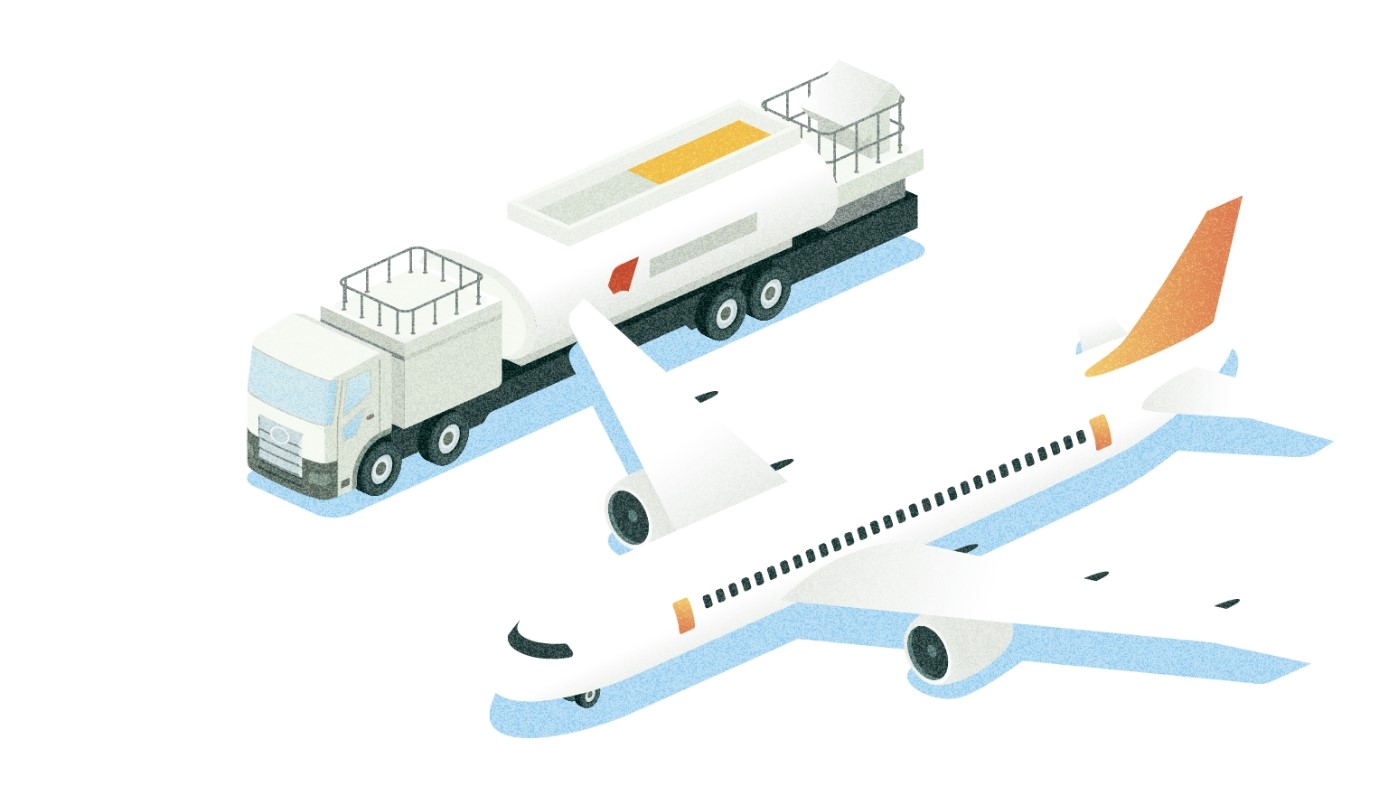
SAF is a general term for aviation fuel produced from sustainable raw materials, and is an abbreviation for "Sustainable Aviation Fuel." Compared to petroleum-derived aviation fuel, it can significantly reduce CO₂ emissions throughout its entire lifecycle, from raw material production to product use. There are several raw material and manufacturing technologies, such as ATJ (Alcohol to Jet: a technology for producing SAF from ethanol) and HEFA (Hydroprocessed Esters and Fatty Acids: a technology for producing SAF by hydrogenating used cooking oils and other fats).
International situation surrounding SAF
The International Civil Aviation Organization (ICAO), of which Japan is a member, introduced CORSIA (*2) in 2021 as one of its global GHG (*1) reduction targets. CORSIA is a system that uses each airline's 2019 CO₂ emissions on international flights as a baseline and imposes an obligation on airlines to purchase emission allowances for emissions exceeding that baseline. The scope of implementation will be gradually expanded, and by 2027 it is expected to apply to virtually all ICAO member states. Along with this, the global market size of SAF, one of the means of decarbonizing the aviation industry, is expected to expand.
In Japan, the government and the aviation industry have set a goal of replacing 10% (approximately 1.7 million kL) of domestic airline fuel consumption with SAF by 2030.
*1 Greenhouse Gas: Greenhouse gas
*2 Carbon Offsetting and Reduction Scheme for International Aviation: A scheme for carbon offsetting and reduction for international civil aviation.
In Japan, the government and the aviation industry have set a goal of replacing 10% (approximately 1.7 million kL) of domestic airline fuel consumption with SAF by 2030.
*1 Greenhouse Gas: Greenhouse gas
*2 Carbon Offsetting and Reduction Scheme for International Aviation: A scheme for carbon offsetting and reduction for international civil aviation.
Why Idemitsu Is Taking on This Challenge and Its Strengths that Enable It to Do So
To contribute to achieving this goal, we are working to establish a domestic supply system for SAF by 2030. While SAF manufacturing technology has only recently been developed and established, we can apply some of the manufacturing processes and knowledge we have cultivated in our petroleum and petrochemical businesses. Furthermore, our existing facilities and network can be utilized for transportation, storage, and supply. Our expertise can also be leveraged for quality control and quality assurance throughout the entire supply chain.
Aircraft are an indispensable means of transportation, not only domestically but also internationally. As a company that has supplied fuel to aircraft, we believe we have a mission to contribute to the decarbonization of the aviation industry through the stable production and supply of SAF.
Aircraft are an indispensable means of transportation, not only domestically but also internationally. As a company that has supplied fuel to aircraft, we believe we have a mission to contribute to the decarbonization of the aviation industry through the stable production and supply of SAF.
Future Developments
We are proceeding with the following considerations for manufacturing SAF at our group Refineries/Complexes in order to supply it domestically.
Chiba Complex
Production demonstration using ATJ (Alcohol to Jet: a technology for producing SAF from ethanol) (100,000 kL/year)
Tokuyama Complex
HEFA (Hydroprocessed Esters and Fatty Acids): Used cooking oils and other fats are hydrogenated.
Manufactured using SAF manufacturing technology (250,000 kL/year)
We are steadily working to secure raw materials in a stable and efficient manner. For ethanol, we are developing overseas suppliers and securing transportation routes. Regarding used edible oils, we are working with LOPS Corporation, which operates an oil and fat business, to consider establishing a stable procurement system. We are also exploring the possibility of using the non-edible oilseed plant "Pongamia" as a raw material and are working on demonstration cultivation in Australia.
*As of March 27, 2026
Chiba Complex
Production demonstration using ATJ (Alcohol to Jet: a technology for producing SAF from ethanol) (100,000 kL/year)
Tokuyama Complex
HEFA (Hydroprocessed Esters and Fatty Acids): Used cooking oils and other fats are hydrogenated.
Manufactured using SAF manufacturing technology (250,000 kL/year)
We are steadily working to secure raw materials in a stable and efficient manner. For ethanol, we are developing overseas suppliers and securing transportation routes. Regarding used edible oils, we are working with LOPS Corporation, which operates an oil and fat business, to consider establishing a stable procurement system. We are also exploring the possibility of using the non-edible oilseed plant "Pongamia" as a raw material and are working on demonstration cultivation in Australia.
*As of March 27, 2026
 return