Special Exhibition "Idemitsu Art Award Artist Selection 2026"
"Idemitsu Art Award Artist Selection 2026" is an exhibition designed to provide ongoing support to artists even after they have received or been selected for the Idemitsu Art Award.
New and recent works by two young artists selected by the judges of the "Idemitsu Art Award 2025" will be exhibited at the "Idemitsu Art Award Exhibition 2026," which will be held in December. For this 15th edition, the two artists selected are Shusuke Tanaka and Yui Furuyama.
Author recommended by judge Fumiko Nakamura: Shusuke Tanaka
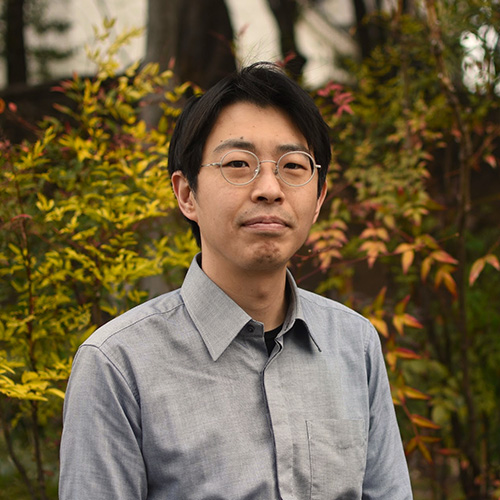
Career
| Birthplace | Wakayama Prefecture |
|---|---|
| 2009 | Graduated from Osaka University of Arts, Department of Fine Arts, Oil Painting Course. |
exhibition
| 2020 | "Summer Vacation Art Museum 10: A Countless Past Days Crowded Together Today" (Wakayama/Wakayama Prefectural Museum of Modern Art) |
|---|---|
| 2021 | "Stagnation Field 2020→2021" (Tokyo/Tokyo Arts and Space Hongo) |
| 2022 | Solo exhibition "Shusuke Tanaka Exhibition: Passing Through Paintings at the Osaka Museum of Natural History" (Osaka/Osaka Museum of Natural History) |
| 2023 | "VOCA Exhibition 2023: Perspectives on Contemporary Art - New Artists of Two-Dimensional Art -" (Tokyo/Ueno Royal Museum) |
| 2024 | Solo Exhibition "A Comparison of Unraveling Situations" (Tokyo/LEESAYA) |
| 2025 | Solo exhibition "When unrestrained light and an unmoved past mingle" (POST Gallery, Seoul, South Korea) |
| 2026 | Solo exhibition "Stay, Wind Flowers" by LEESAYA (Tokyo/CADAN Otemachi) |
Awards etc.
| 2014 | Shell Art Award 2014: Chieko Kinoshita (Selected Artist) |
|---|---|
| 2018 | Haruhi Painting Triennale Runner-up Prize Winner |
| 2023 | Recipient of the 2023 Sakuya Konohana Award |
| 2024 | Recipient of the 2024 Wakayama Prefecture Cultural Encouragement Award |
Reference work: "Slowly Immersing Myself in Color"
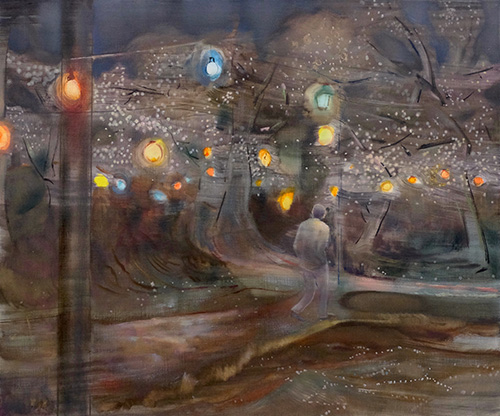
Technique: Oil on canvas
60.7 x 72.8 cm
About the work/production
Every day, as I ponder, contemplate, and grapple with all sorts of things, I am suddenly deeply moved when I encounter a certain object. This object can be a person, an object, or an environment, but it is not something unrealistic. It may be something insignificant, and I have simply perceived it as something special. I have no way of knowing at the time why I perceived it that way—whether it was some kind of suggestion, an emotional ups and downs such as joy or sadness, a sense of unease, or something else entirely. But in that moment, my heart is stirred, and I feel compelled to paint it. For me, painting is a way to bring that object closer to me and to reveal what I felt from it. Painting that object is not simply a depiction of reality as it is. I distort reality based on what I saw and the sensations I experienced at that moment, reinterpreting and interpreting it. As a result, the object becomes a painting.
Comments from Judge Nakamura
Kyoshi Takahama, a giant of modern haiku, advocated "objective depiction." This means eliminating subjectivity and confronting things objectively. However, since it is created by humans, subjectivity cannot be completely eliminated, and a significant transformation is unavoidable in the process of depicting the subject before one's eyes in 17 syllables. Perhaps Kyoshi argued that by not being unnecessarily bound by one's own subjectivity, and by contemplating how to capture the subject before one's eyes, even when writing about ordinary things, a presence that transcends the subject itself will emerge.
The same is true of Shusuke Tanaka's paintings. Tanaka depicts objects, people, and landscapes he encounters in his daily life as they are. Many of these are found in the city of Osaka, where he lives. Yet, despite this, his paintings give off a somewhat unusual impression. It's as if a layer of film covering the everyday landscape has been peeled away. And the extraordinary nature of the act of fixing what one has seen onto the canvas with a paintbrush also comes to light.
Author recommended by judge Toshiharu Suzuki: Yui Furuyama
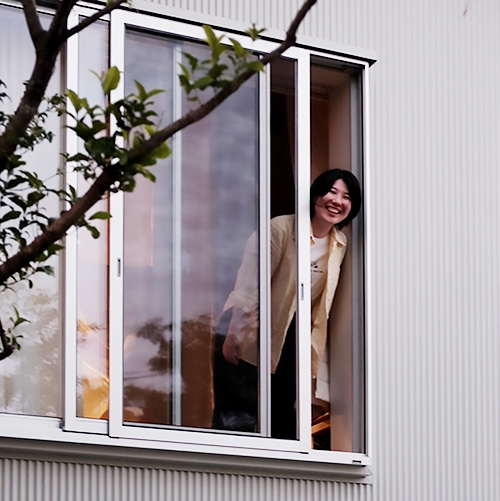
(Photo by Yumi Oguro)
Career
| Birthplace | Aichi prefecture |
|---|---|
| 2016 | Graduated from the Department of Painting, Faculty of Fine Arts, Tokyo University of the Arts, specializing in Japanese painting. |
| 2018 | Completed Master's Program in Painting, Japanese Painting Area, Graduate School of Fine Arts, University of the same university. |
| 2021 | Completed the doctoral course at the same university's Graduate School of Fine Arts and Ph.D. (Fine Arts) |
exhibition
| 2022 | Solo exhibition "Close-up and Distant Views" (Tokyo/CLEAR GALLERY TOKYO) "New Artists of Today Exhibition 2022: Capturing the World - Yui Koyama, Tatsuya Kobayashi, Kiyoka Osaki" (Kanagawa/Yokohama Civic Gallery) |
|---|---|
| 2023 | Solo exhibition "Discrete Circles" (Tokyo/Taku Sometani Gallery) Yui Furuyama & Ai Yoshida Two-Person Exhibition "Gathering and Pulling" (Kanagawa/Gallery Pictor) |
| 2024 | Solo exhibition "Blind Spots in Everyday Life" (Tokyo/twililight) The 18th Lantern Painting Exhibition "Hijiori no Akari" Lantern Painting Production |
| 2026 | Solo exhibition "Floating in Winter Days" (Tokyo/TS4312) |
Awards etc.
| 2022 | Awarded Excellence Prize at the "Tsukuba Prize for Painting" Exhibition 2022. |
|---|---|
| 2023 | Idemitsu Art Award 2023 Sachiko Shoji Jury Prize (National Art Center, Tokyo) Winner |
| 2024 | Received the Encouragement Award at the 12th "Go Sakura Museum Cherry Blossom Award" Exhibition. |
Reference work: "grain, candy, granules"
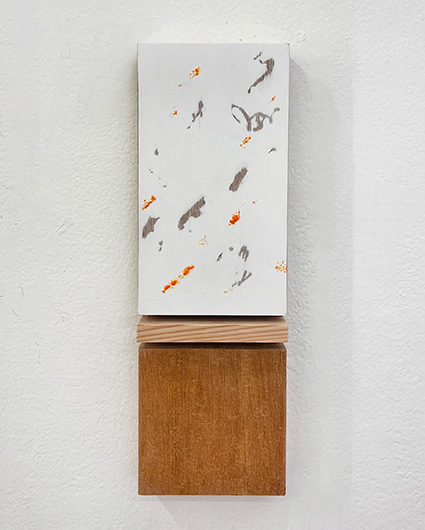
Technique: Wooden panel, wood, μ-ground, mineral pigments, animal glue
17.9 x 24 x 3 cm
About the work/production
For me, the creative process is similar to writing words.
Furthermore, I've recently come to think that it's also important to investigate things thoroughly.
I felt that the finished pieces were "object-like," and for a long time I couldn't figure out why, but recently I've come to think that they might be "containers." I hope I can create a good container.
Judge Suzuki's recommendation comment
Scratching, sanding. Adding, removing. Creating the inside, creating the vessel. Sometimes it feels like all the experiments in painting have been done, like there are no more possibilities left, but I always wonder if that's really the case. Furuyama's work, however, which comes from studying traditional Japanese painting, doesn't take a grand stance, but rather has a feeling of just trying things out. At the same time, or perhaps I should say, even so, the question of what kind of image a painting can retain in such a situation, or at least what Furuyama's paintings can retain, seems to be a pressing issue. Paintings that are still undefined, tentative, light, yet earnest.