Idemitsu Art Award 2025 Grand Prize Winner Interview
Just keep drawing for yourself
—Idemitsu Art Award 2025 Grand Prize Winner Ryo Endo
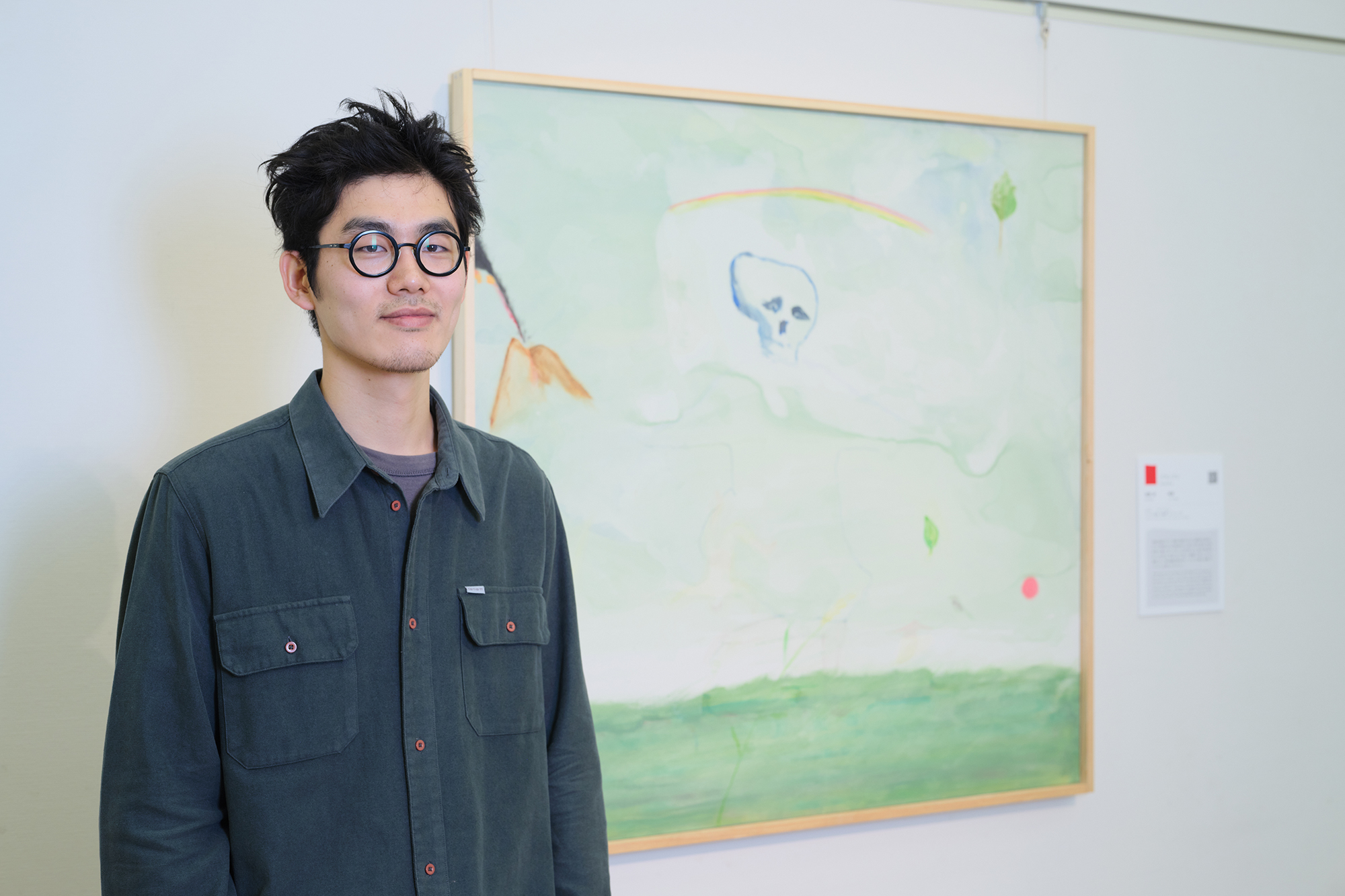
The Idemitsu Art Award (formerly the Shell Art Award), sponsored by Idemitsu Kosan, is an open-entry art award for artists under the age of 40. It supports the creativity, challenges, and growth energy of the younger generation who are exploring the possibilities of two-dimensional art.
This year's judges are Shu Oura (Chief Curator, Museum of Modern Art, Saitama), Toshiharu Suzuki (Curator, Toyota Municipal Museum of Art), Mizuki Takezaki (Curator, Marugame Genichiro-Inokuma Museum of Contemporary Art), Fumiko Nakamura (Chief Curator, Nakanoshima Museum of Art, Osaka), and Shinnosuke Yoshida (Artist, Runner-up in the Shell Art Award 2009).
This year marks the 54th time the awards have been held, and Ryo Endo was selected as the Grand Prix winner from among 933 entries by 734 artists, receiving a prize of 3 million yen. Endo was born in Shizuoka Prefecture in 1997 and currently lives in Tokyo. He has never studied art at a specialized educational institution such as an art university, and this was his first attempt at an open exhibition while painting on his own, which led to him winning the Grand Prix.
Ahead of the Idemitsu Art Award Exhibition 2025, which will display eight award-winning works, including the Grand Prix, and 46 selected works, we spoke to Endo about his award-winning works and his creative activities to date.
Taking on the challenge of public exhibitions and using it as a creative engine
─ Congratulations on winning the Grand Prix of the Idemitsu Art Award 2025. How did you feel when you received the news of your win?
I was nervous when I received the news. Of course, I was very happy, but I think my wife and mother were happier than I was.
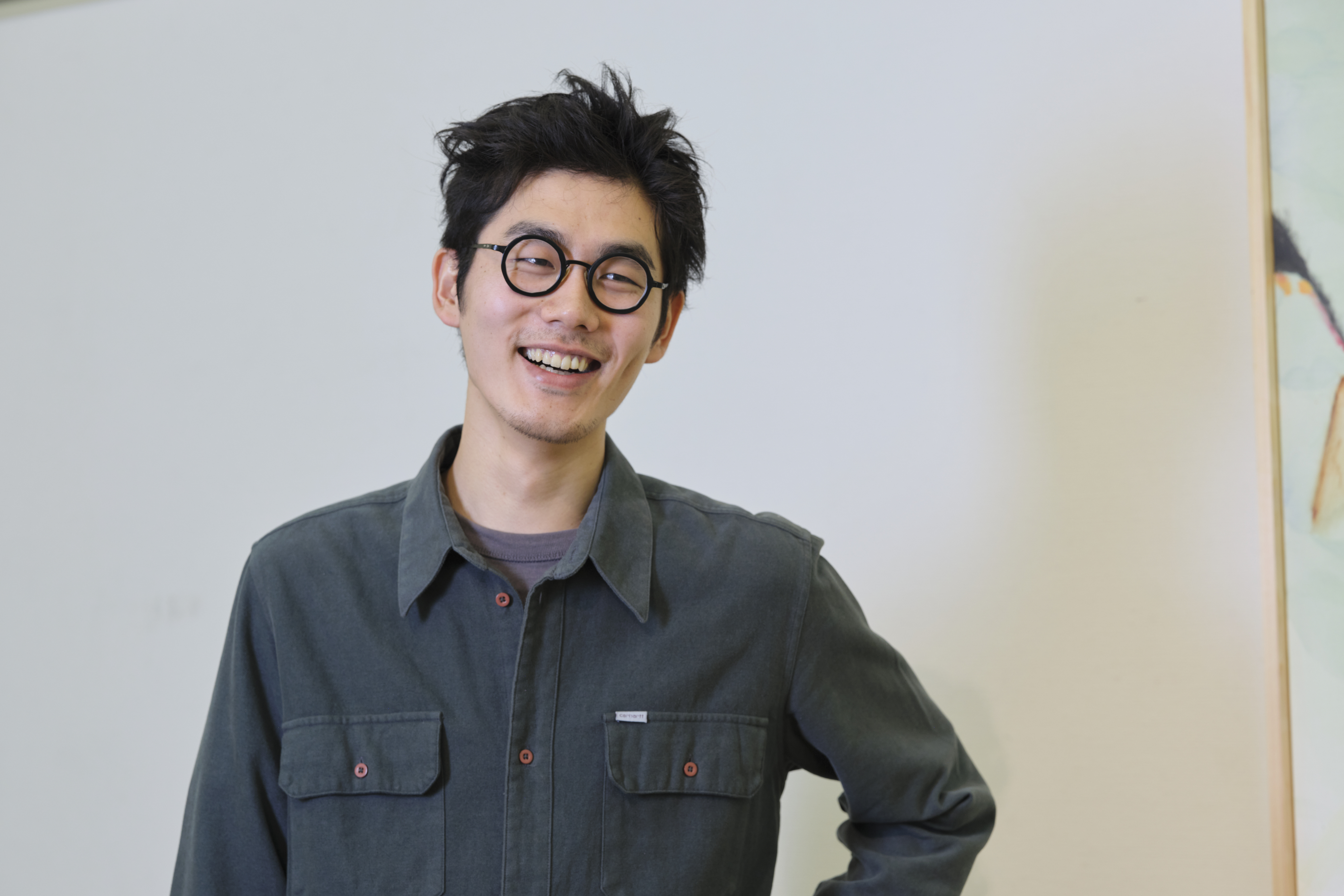
Ryo Endo was born in Shizuoka Prefecture in 1997. After graduating from the Department of Commerce at Komazawa University in 2020, he entered the Graduate School of Professional Accounting at Aoyama Gakuin University, graduating in 2022. During his student days, he aspired to become an accountant, but after graduating from graduate school, he decided to pursue the path of painting, which he had been doing since childhood.
-- I'm glad that your family was pleased with your work. Have you applied for the Idemitsu Art Award before?
No, I had never entered the Idemitsu Art Award or any other open exhibitions. I will be moving to my hometown of Shizuoka next spring, so I applied for the first time with the intention of trying something new while I am still in Tokyo.
In Tokyo, there are plenty of connections with people, information, and museums and galleries, so by posting my drawings on Instagram, I started getting offers to exhibit and be featured in magazines. I think you can create art wherever you are, but I thought that if I could win the grand prize at an open exhibition now, it would motivate me even more.
─ Out of the many open exhibitions available, why did you choose the Idemitsu Art Award?
The judges were curators from my favorite art museums, so I really wanted them to see my work. Also, there were some winning works from the Shell Art Prize that I liked, and they had some things in common with my own work, so I thought it would be meaningful to be recognized here.
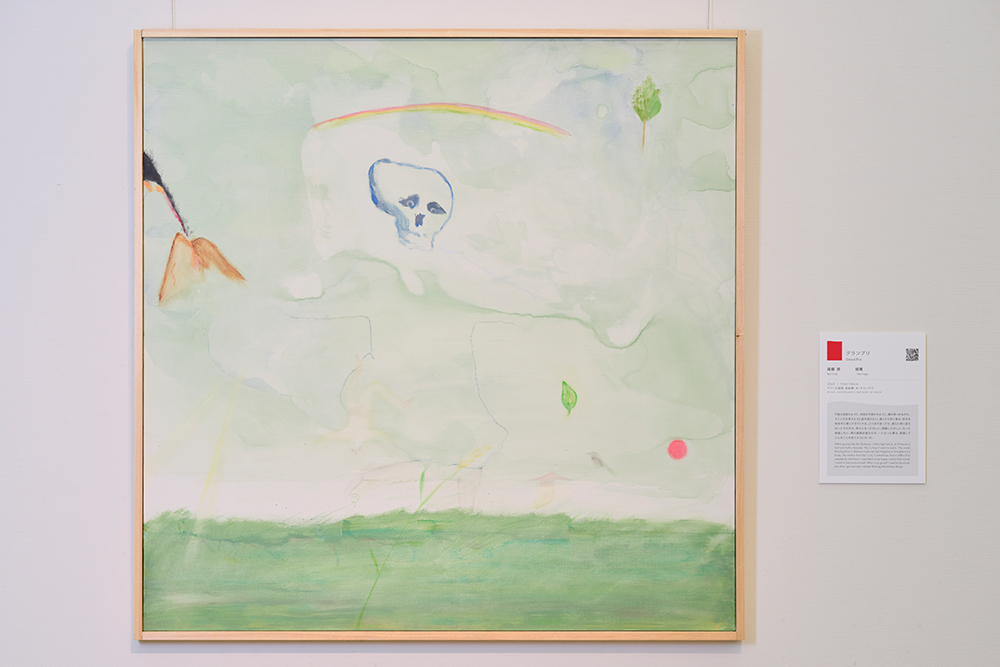
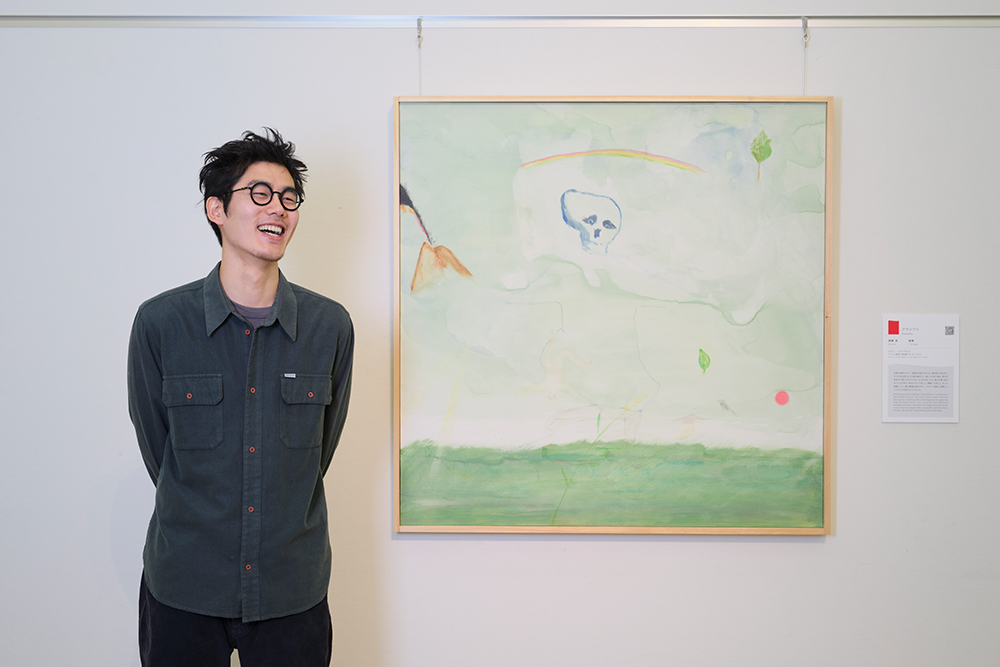
Ryo Endo "Marriage" 2025, 116 x 116 cm, acrylic paint, colored pencil, water, canvas
Keeping production "as usual" in mind
- How did you prepare for your application?
First, I decided to try my hand at a larger piece. I usually paint acrylic paintings on smaller canvases, or I collect my favorite papers, such as packing paper or straw paper, and use them to make drawings *1. In the past, I've also painted on business card- or postcard-sized paper.
It had been a while since I'd drawn a large piece, and I was worried that if I concentrated on just one piece, the picture would end up being strangely stiff, so I worked on two pieces to submit at the same time to avoid straining myself. Furthermore, it felt unnatural to change the way I drew as soon as the size became larger, so I decided to try drawing a large piece as if I were using a pencil, without paying too much attention to the paints as usual.
--How did you go about creating this piece, including the techniques and methods of expression you used?
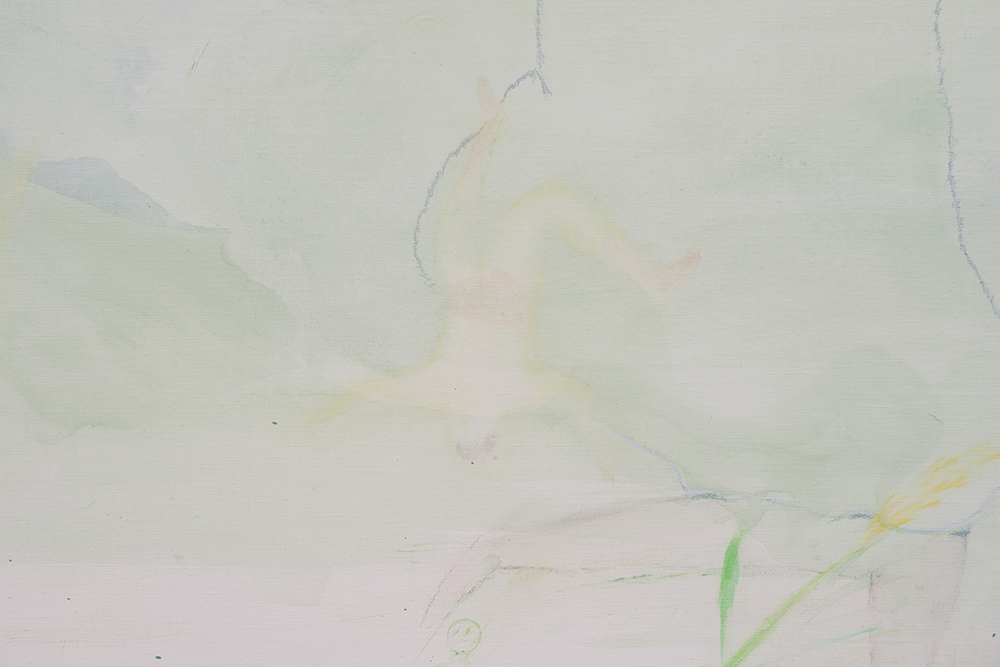
This time, in the "Materials" column of the caption, I wrote "Water" in addition to "Acrylic, Canvas" (laughs). After painting layers of color, I lay the canvas flat and drip water on it, or stand it up and drip water from above. I start with a light color and change the color tone by adjusting the amount of blur. I paint while changing the orientation so that it is difficult to distinguish between the sky and the ground, or the top and bottom, and once I have a background I am satisfied with, I look at the whole canvas.
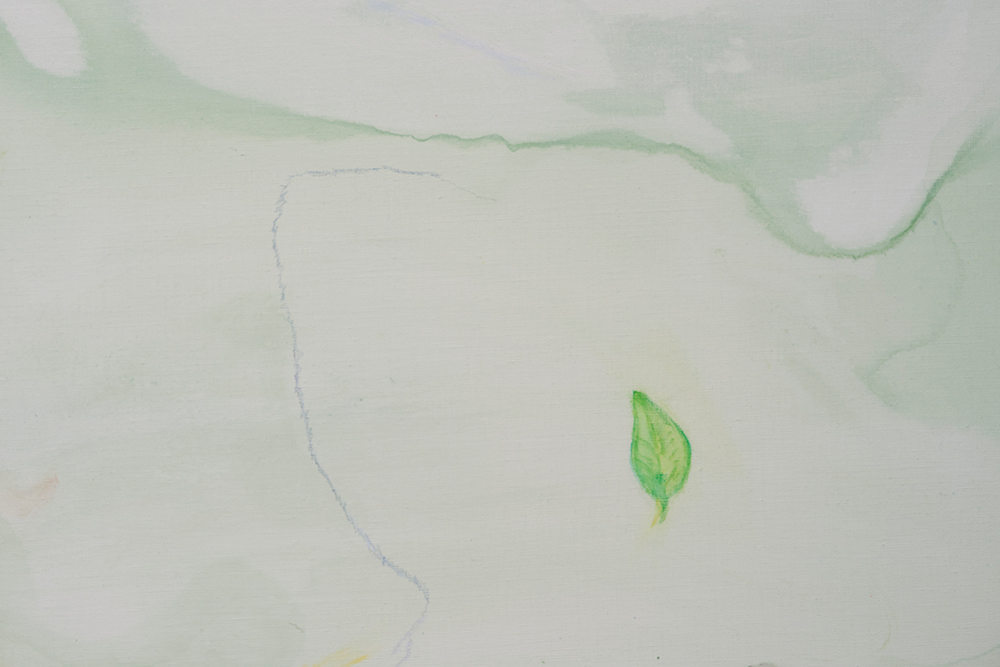
The part where you can clearly see that water is dripping
I don't have an idea of what I want to draw first, but rather draw whatever comes to mind as I observe the picture plane. With this piece, the image of a skull and skeleton first came to mind, and then other images popped out one after another, as if they were associations. I can't draw with a specific goal in mind, so I just went with the flow as I worked, and on the morning of the delivery day, I decided that it would be better to draw the body after all, so I added some lines.
--So you don't have a theme or plan before you start drawing?
That's right. I don't paint for anyone else, nor do I paint with any social or political themes in mind; I paint simply to satisfy myself. People sometimes tell me that my paintings are gentle, but they also express the violent, cold, and poisonous side of me.
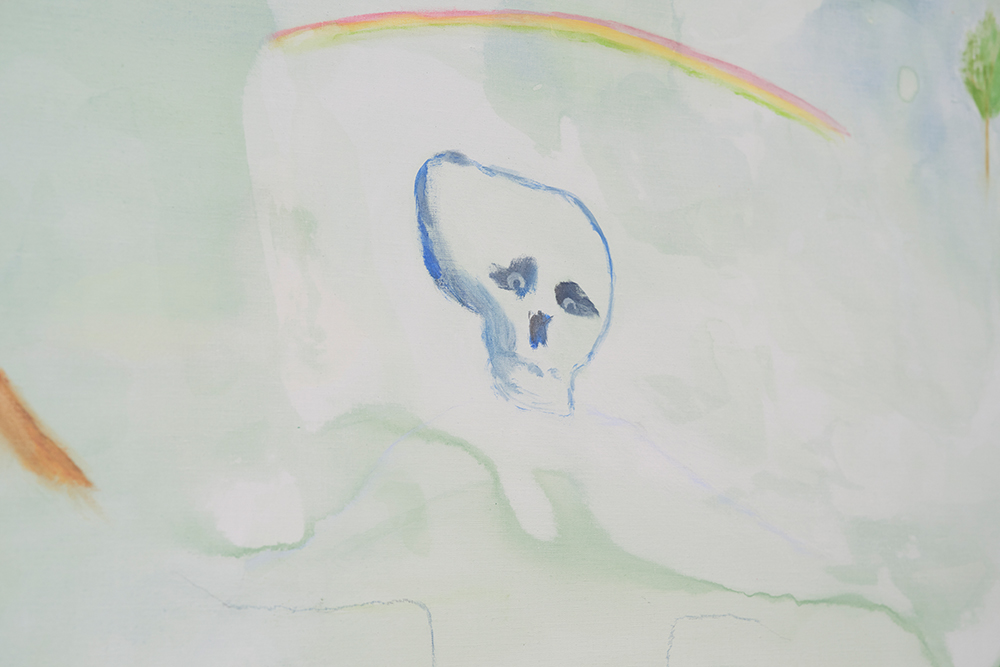
--So the title of the work, "Marriage," wasn't something you had in mind from the beginning, but rather something you added after the work was completed?
That's right. I just got married in June, and some of my friends said it was amazing that I was able to draw a skull despite being newlyweds, but I wasn't being sarcastic about it (laughs).
I initially thought of the title "HEAVEN" because I like the sound of the music and religious and spiritual paintings. However, I felt that it was vague and not grounded in reality, and then the word "marriage" came to mind, which felt right, so I chose it.
When I was single, I was absorbed in painting, but after getting married, I not only had more time to paint, but also to spend more time with my family, and it feels like I'm getting my "life" back. Even in my daily life, the canvas is always in the back of my mind, and the things I feel and the things that come out of my daily life provide good inspiration for my paintings.
I have been drawing in my daily life since I was a child.
--When did you start drawing?
I attended an atelier class in my hometown of Shizuoka when I was in the lower grades of elementary school. Rather than being taught techniques, it was a place where I could create what I wanted to create, such as painting pictures on fallen leaves I picked up or making my own world out of cardboard boxes. If I didn't understand something, I would get advice.
I was also creating collages *2, which may have led to my current style of drawing, in which motifs are arranged in a simple manner. It was around that time that I realized that drawing was something special to me.
When did you start to think that you wanted to become an artist?
Living in the countryside, I thought that people who worked in the arts were the chosen ones, and there was a time when I thought it was fine even if my work wasn't released to the world, because I could draw pictures in my daily life even if it wasn't a job.So I went to graduate school to take over the family business of a tax accountant's office, but the year before I finished, an acquaintance encouraged me to decide to become an artist instead of pursuing a career as an accountant.
Have you ever exhibited your work?
In 2022 I started posting my paintings on
Instagram
, and around the time I started to feel more ambitious as an artist, I was approached by a cafe gallery called Sennenichi Coffee Roastery in Tsukuba City, Ibaraki Prefecture, where I exhibited and sold my work.
I thought it would be amazing if I could sell just one piece, but I was surprised at how many I sold. Until then, I had been living with the feeling that I didn't have a job that I wanted to do, so I was grateful that there were people who thought my work was good and bought it, and it gave me a sense of satisfaction that it was money I had earned myself, so it motivated me to work harder as an artist.
─ That's encouraging. How did you get started on Instagram?
I'm self-taught in art, have no connections, and am not good at promoting myself, but I started because I felt I had to get some kind of message out.
Exhibitions are one way of communicating, but rather than paying for and renting a space myself, I hold them when requested and in a place that I am happy with.
I have also self-published two collections of my work: "TORITOSAKANA," a collection of my daily drawings of birds and fish, and "Works by RyoEndo 26th November 2022 to 25th March 2024," a two-year illustrated diary of a fictional character named "Barisan." The latter is a compilation of around 600 drawings per day, compiled into a collection of around 350 pages.
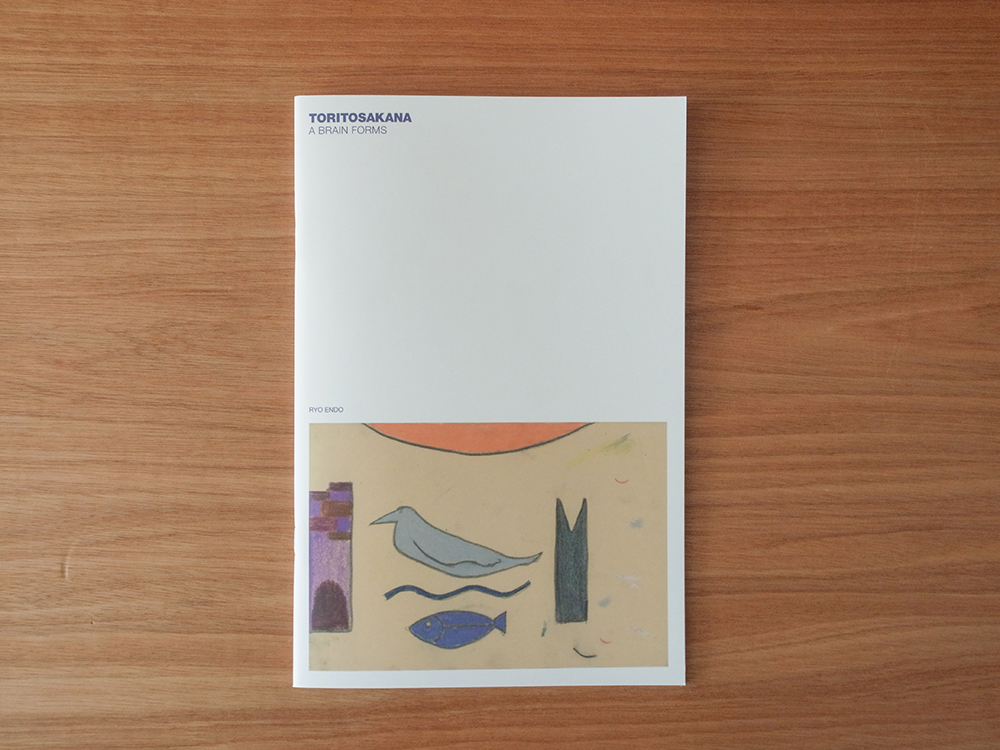
"TORITOSAKANA" 52 pages, 2024, self-published
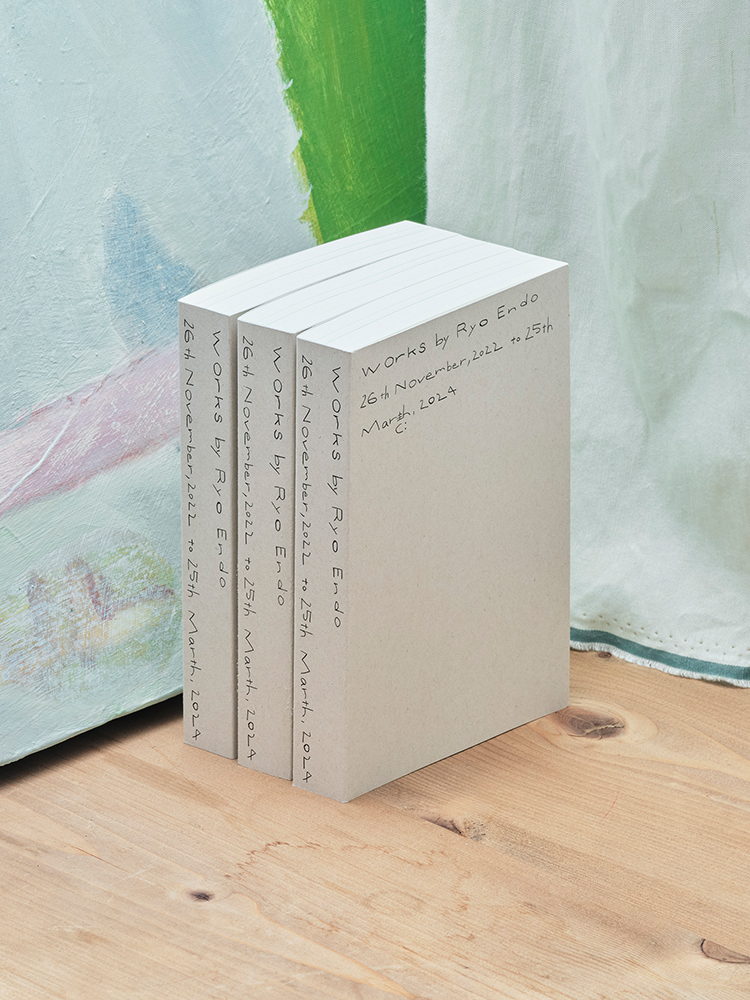
"Works by RyoEndo 26th November 2022 to 25th March 2024" 344 pages, 2025, self-published, book design: Natsuko Yoneyama, photography: Reio Arimoto
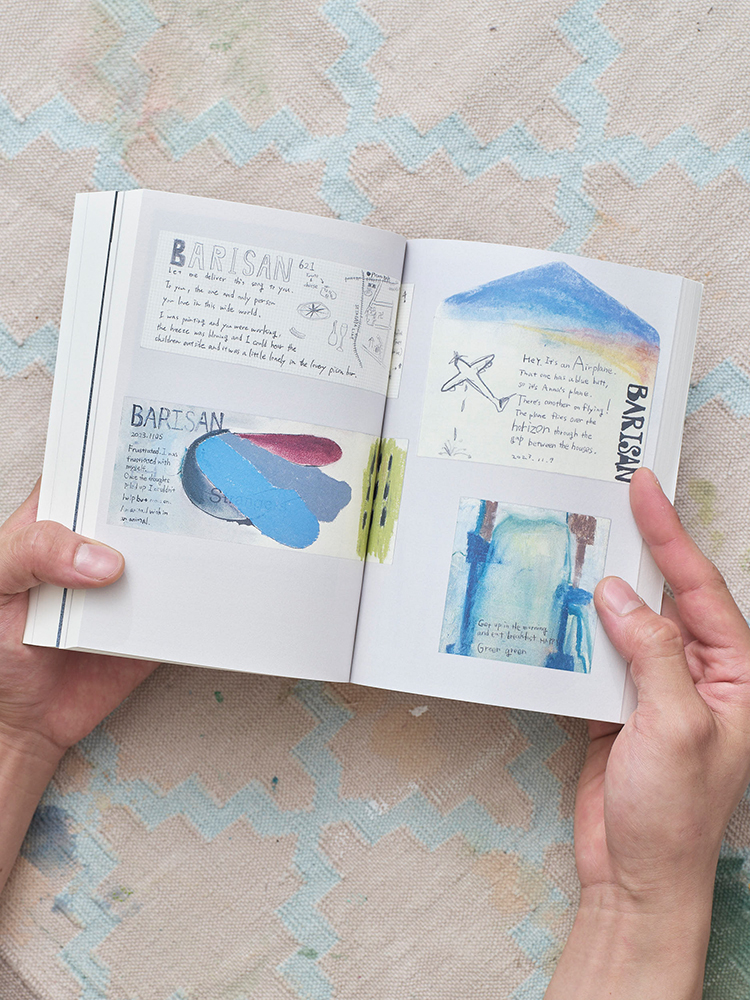
The style of drawing in the illustrated diary changes with each passing day.
─ The style is different from the award-winning work, and this one is also good.
Thank you. I like fonts, so for my fictional picture diary I combine English and pictures into one picture, and have the main character say what I want to say (laughs). As with the award-winning work, I have always valued humor in the things I draw honestly. My sense of humor, like black humor and not being serious, and being a little playful, hasn't changed since the old days.
I want to depict a world that is not just beautiful, but also includes violence and unavoidable events.
-- In your acceptance speech, you wrote, "Rather than having a clear message I want to convey in each and every work, there is a consistent message in everything I draw." Could you tell us what that message is, and how your winning work relates to it?
I kind of regret writing "message" (laughs). For example, if a river is muddy the day after a heavy rain, it may look beautiful from afar, but if humans actually set foot there, they could not survive; nature is an existence that humans cannot compete with.
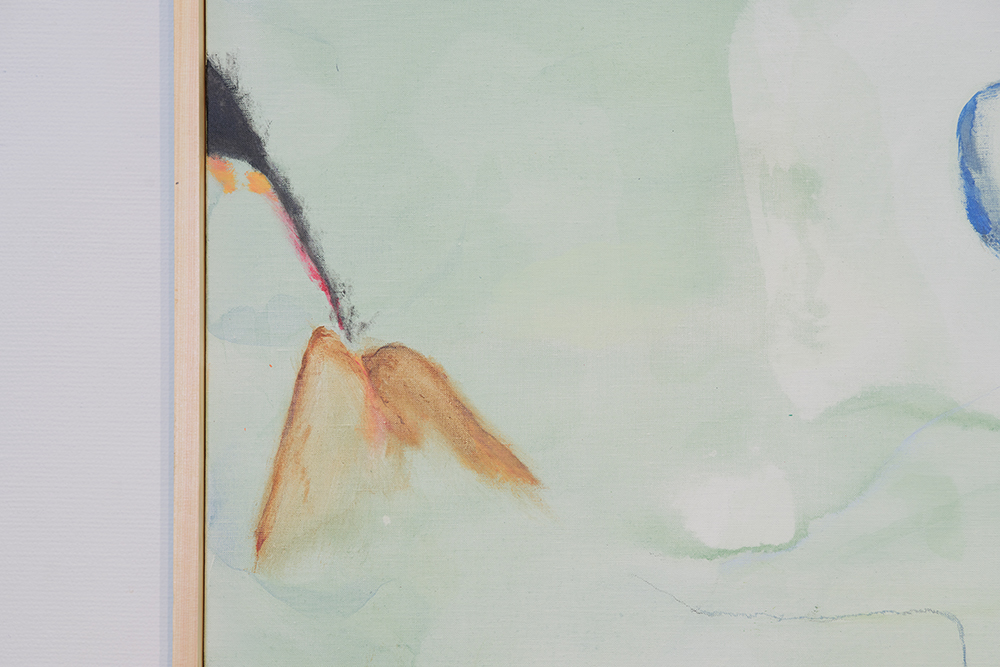
Rather than just depicting the beautiful parts, I want to depict those unattainable, unavoidable, and violent parts coexisting on the same canvas. An erupting volcano (which I also depicted in my Grand Prix-winning work, "Marriage") is something that brings disaster to humans, but is also a source of energy for the natural world; I think it's because of these good and bad sides that the world is beautiful and fun.
As a viewer, I find paintings that appeal to me are ones that instantly touch the depths of my sensibilities, even without consciously looking at them. I hope to be able to create works like that.
─ Your work will be exhibited at the "Idemitsu Art Award Exhibition 2025." Is there anything in particular you would like visitors to look out for?
I think what you see will change depending on the distance from which you view the painting, so I would be happy if you could look at it from a distance, moving closer or further away. Once I paint a picture, the work becomes distant from me, so I hope each viewer can enjoy it in their own way. When I stand in front of the painting, I feel like I am also a viewer, thinking about it together with them.
─ Is there anything you would like to try in the future?
I would like to exhibit my work in a white cube gallery to see how it looks.
─ Please give a message to those who are thinking of applying for next year's Idemitsu Art Award.
I imagine that many of the applications for these types of open exhibitions come from people studying academically at art universities, but I would also encourage people like me who have not received specialized art education to give it a try without hesitation.
-- It seems likely that the Idemitsu Art Award will bring about greater diversity and vitality as its reach expands. We look forward to your continued success, Mr. Endo. Thank you for your time today.
First published on the contest information site "Toryumon"
Text: Yuri Shirasaka Photographs: Seiji Ishigaki Editing: Atori Hagiwara (JDN)
*1 Drawing:
The creative act of expressing shapes and compositions primarily through lines and brushstrokes. Often refers to hand-drawn expressions using materials such as pencil, pen, charcoal, and ink.
*2 Collage:
A technique of constructing a single image by cutting and pasting different materials such as pieces of paper, photographs, fabric, and printed matter. A method of expression that creates new meanings and visual effects by reconstructing existing images and materials.