Seismic and Direct Detection Technologies that Visualize Oil and Gas
Direct detection technology (DHI) for seismic exploration to "visualize" oil and gas
Idemitsu has contributed to improving the success rate of exploratory drilling in exploration and development projects in Norway, Vietnam, and other regions by leveraging direct hydrocarbon detection (DHI) technologies based on seismic and rock physics. In recent years, the company has also been actively engaged in research and development of advanced technologies such as Elastic FWI *1.
While there are various geophysical exploration methods, such as gravity exploration and electromagnetic exploration, seismic exploration is widely used in oil and gas field exploration. This exploration technique involves sending artificial elastic waves into the subsurface and measuring the reflected waves to accurately determine the shape of the subsurface geological structure, such as faults and major geological boundaries. In recent years, in addition to elucidating the subsurface geological structure as in the past, there has been increasing use of Direct Hydrocarbon Indication (DHI), a technology that directly detects the presence of oil and gas through quantitative analysis of lithology and fluid properties based on petrology. There are various methods of geophysical exploration, such as gravity and electromagnetic surveys, but the technique most widely used for oil and gas exploration is seismic surveying *2. In this technique, artificially generated elastic waves are sent into the subsurface and the reflected waves are measured, enabling high‑precision imaging of subsurface geological structures such as faults and major formation boundaries. In recent years, in addition to conventional structural interpretation on seismic profiles, techniques known as Direct Hydrocarbon Indication (DHI), which directly detect the presence of oil and gas accumulations through quantitative analysis of rock and fluid properties based on rock physics, have come into wider use.
Idemitsu was among the first to undertake research in this field and has since worked to develop a team of experts well versed in DHI technologies, while also building an analytical environment using dedicated software. By applying this technology to the evaluation of oil and gas fields in actual exploration projects, the company has helped improve discovery success rates at numerous fields, including in Norway. At the Sao Vang and Dai Nguyet gas fields in Vietnam, where Idemitsu is the operator producing natural gas, this technology is also being applied to achieve optimized exploration and development.
In the oil and gas upstream industry, research on seismic acquisition and processing has advanced rapidly in recent years, and technologies such as Full Waveform Inversion (FWI), which provide high‑resolution imaging of subsurface structures, are evolving. Aiming to apply such cutting‑edge technologies to direct detection of oil and gas accumulations, Idemitsu is conducting joint research with the University of Tokyo on elastic FWI technology, which utilizes not only conventional reflected waves but also S waves and refracted waves.
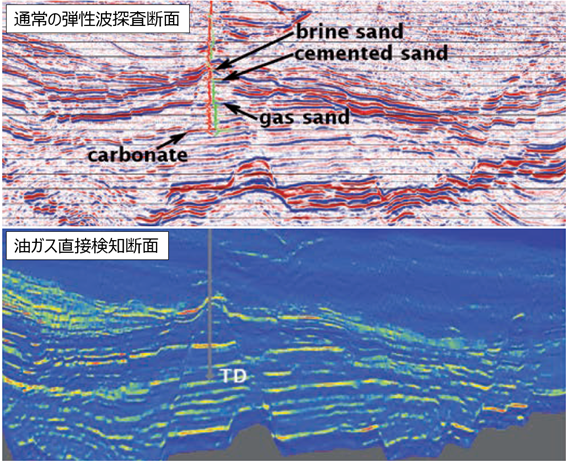
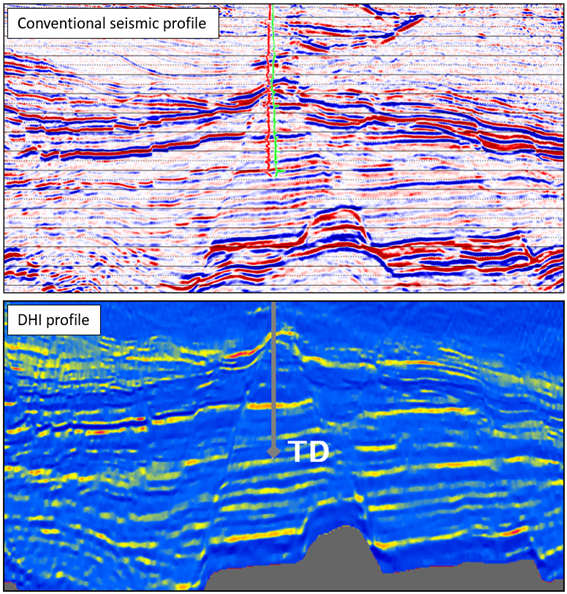
A conventional seismic section (upper) and a section indicating the potential for oil
and gas accumulations using DHI technology (lower; warmer colors indicate higher potential).
Source:Tsuneyama et al., 2014. Characterization of hitherto unseen reservoirs: a case study of lithology and fluid prediction using seismic QI. First Break volume 32.
-
Elastic FWI (Elastic Full Waveform Inversion): A high‑resolution analysis method that estimates subsurface structures and rock properties by utilizing the entire elastic wavefield, including refracted waves and S‑waves, in addition to P‑wave reflections.
-
Seismic survey: An exploration technique that investigates subsurface geological structures and physical properties by transmitting artificially generated vibrations (elastic waves) into the ground and analyzing their reflections and propagation characteristics.