What is functional feed?
Functional feed
Functional feed is an essential input for global food production. It plays an important role in improving livestock productivity, supporting animal health, and maintaining the yield and quality of livestock products.
Functional feeds are produced by formulating functional ingredients, such as natural extracts and chemically synthesized compounds. They are classified into feed additives, which consist only of specified ingredients, and compound feeds, which are mixtures of specified ingredients and feed materials. The Idemitsu Group supplies both types.
The Idemitsu Group has commercialized functional feed products such as RUMINUP, which contains cashew nut shell liquid (CNSL) as the active ingredient, and MOLUCCA, which contains Bacillus subtilis (natto) as the active ingredient.
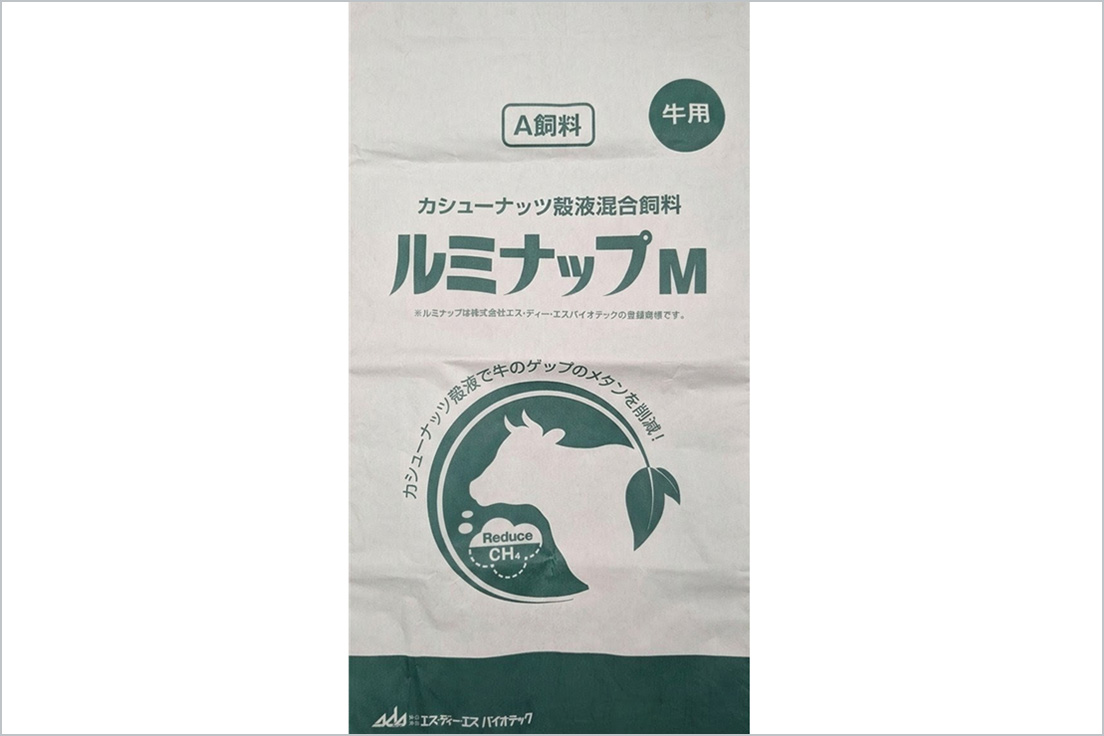
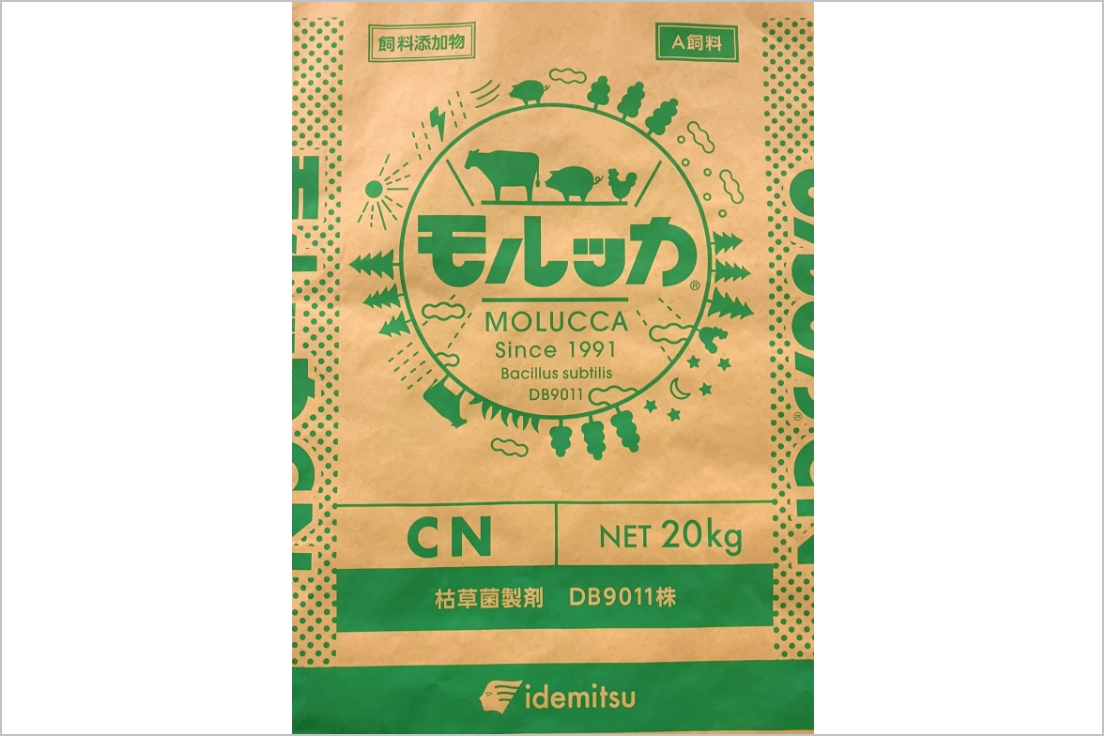
Cashew Nut Shell Liquid helps reduce methane emissions from cattle belching
Cattle have four stomach compartments. The first compartment, the rumen, contains numerous microorganisms that ferment ingested forage and convert it into nutrients and energy. Methane, a greenhouse gas, is generated during this fermentation and is released into the atmosphere mainly through belching. In CO₂-equivalent terms, methane emitted through belching by livestock ruminants (such as cattle, sheep, and goats) is estimated to amount to approximately 2 billion tonnes per year worldwide, which is equivalent to about 4% of anthropogenic greenhouse-gas emissions globally. Accordingly, methane emitted by livestock has drawn increasing attention as climate-change mitigation efforts accelerate worldwide.
One key to addressing this issue is cashew nuts. Studies have reported that feeding cattle with feed containing CNSL reduces methane emissions from the rumen.*Research is also under way into its effects on milk yield and reproductive performance, weight gain in beef cattle, and maintenance of rumen function.
CNSL designated by MAFF as a feed additive for reducing methane emissions from cattle belching
In May 2025, CNSL was designated by Japan’s Ministry of Agriculture, Forestry and Fisheries (MAFF) as a feed additive for reducing methane emissions from cattle belching. CNSL is the first naturally derived ingredient to receive this designation.
CNSL is rich in natural phenolic compounds such as anacardic acid. By acting on the rumen microbiota, it reduces methane generation that would otherwise be emitted through belching. The government recognized this effect and designated CNSL under the feed-additive use category “supplementation of nutritional components and other effective ingredients in feed” for the purpose of reducing greenhouse-gas emissions.
In February 2026, CNSL was also registered under the J-Credit Program’s Agriculture Category (AG Category) as “Methodology AG-007 (ver.1.0): Feeding feed using feed additives for cattle (those contributing to the reduction of greenhouse gases in belching).”*Although CNSL can be challenging to handle, our Group has developed processing technologies that improve handling and stabilize the active ingredients, enabling safe feeding to livestock.
-
J-Credit: Japan’s J-Credit Scheme is a government certification program that certifies, as “credits,” the amount of CO₂ and other emissions reduced through the introduction of energy-saving equipment and the use of renewable energy, as well as the amount of CO₂ absorbed through appropriate forest management. (Source: J-Credit)

Examples of products containing CNSL
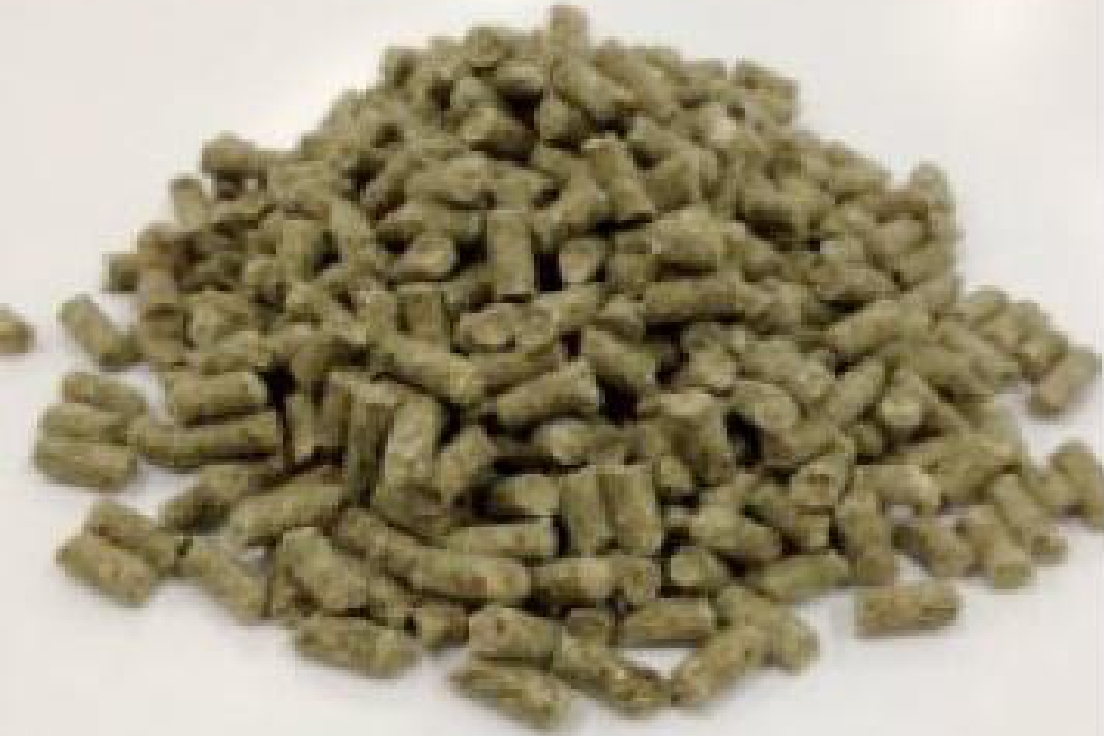
-
In a test simulating fermentation in the bovine digestive tract, methane production was reduced by approximately 36% (equivalent to about 0.5 t CO2e per head per year).
Inhibitory effect of CNSL at a concentration of 50 ppm in an artificial rumen test (Watanabe et al., 2010).