




2025.06.10
A report from the field on "agricultural solar power generation" that combines agriculture and solar power generation!
What is agricultural solar power generation?
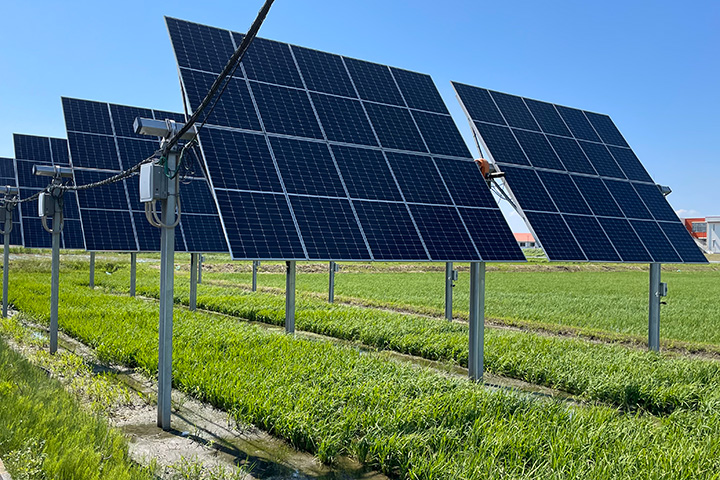
In recent years, "agricultural solar power generation" has been expected to be one of the solutions to the issues facing agriculture and renewable energy in Japan. Agricultural solar power generation involves installing solar panels on farmland and generating solar power in parallel with growing crops on the land.
Agriculture faces challenges such as a lack of successors and abandonment of farmland, as income is difficult to stabilize due to factors such as harvest volume, quality, and market prices. As for solar power generation, the number of suitable sites for installing large-scale power plants is decreasing, which is one of the challenges for expanding renewable energy in Japan.
Agricultural solar power generation is attracting attention as it has the potential to solve these issues.
Agriculture faces challenges such as a lack of successors and abandonment of farmland, as income is difficult to stabilize due to factors such as harvest volume, quality, and market prices. As for solar power generation, the number of suitable sites for installing large-scale power plants is decreasing, which is one of the challenges for expanding renewable energy in Japan.
Agricultural solar power generation is attracting attention as it has the potential to solve these issues.
Idemitsu Kosan began a demonstration of agricultural solar power generation in a rice field in Kisarazu City, Chiba Prefecture in June 2023.
How can we balance agriculture and power generation?
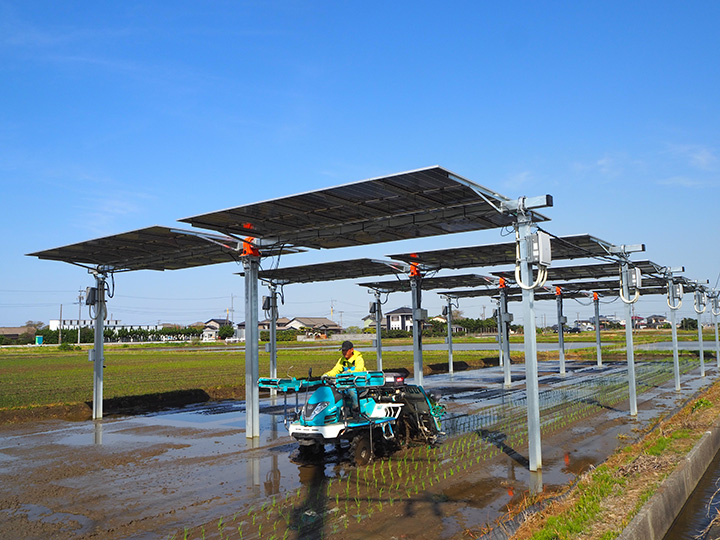
In agricultural solar power generation, poles are erected on farmland and solar panels are placed on top of them.
As you can see from the photo, there is ample working space, and work can be done without any problems while riding on the rice transplanter.
However, if things continue like this, the panels will block sunlight and will not be able to provide enough light to the farmland.
When carrying out agricultural solar power generation, the system stipulates that the yield must not be reduced by more than 20% compared to the average yield per unit area. In other words, power generation must be prioritized and the yield must not be significantly reduced.
As you can see from the photo, there is ample working space, and work can be done without any problems while riding on the rice transplanter.
However, if things continue like this, the panels will block sunlight and will not be able to provide enough light to the farmland.
When carrying out agricultural solar power generation, the system stipulates that the yield must not be reduced by more than 20% compared to the average yield per unit area. In other words, power generation must be prioritized and the yield must not be significantly reduced.
In order to meet these standards, Idemitsu Kosan is currently conducting demonstration experiments on agricultural solar power generation, and various innovations are being implemented in the solar panels.
[Growth mode that maximizes the amount of sunlight that reaches the crops]
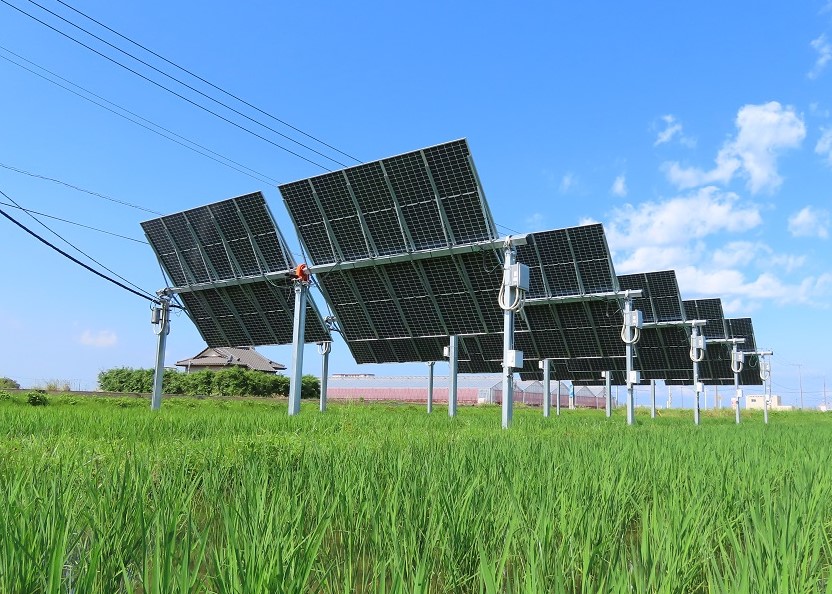
During the growing season, the angle of the sunlight is controlled so that the panels are always parallel to the sunlight, ensuring that the sunlight hits the crops. In addition, because the panels are double-sided, they can capture not only sunlight, but also the light reflected from the water surface of the rice paddies and the rice ears, and generate electricity.
[Power generation mode that maximizes power generation]
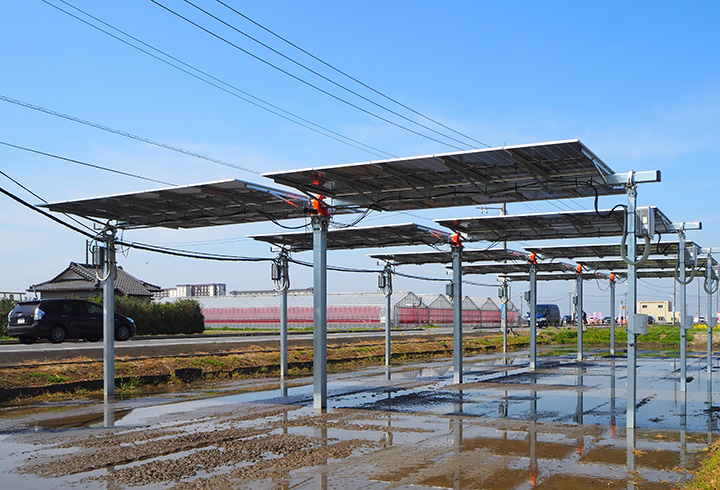
During periods when crops are not being grown, the panels are adjusted to be perpendicular to the angle of the incoming sunlight, ensuring that sunlight hits the panels, maximizing the amount of electricity generated.
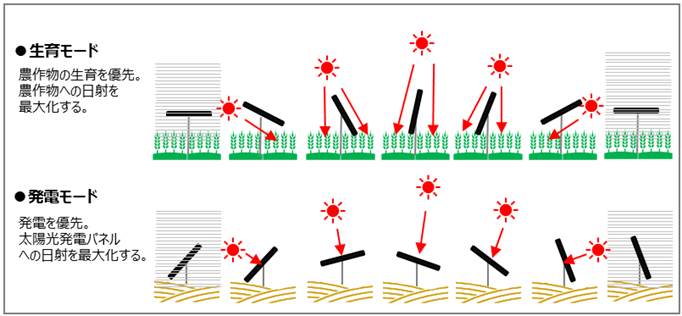
With conventional agricultural solar power generation, the panels are fixed in position, so the amount of sunlight reaching the crops varies depending on the position of the sun, and it is not possible to control the amount of sunlight reaching the crops.
As shown in the diagram above, Idemitsu Kosan's agricultural solar power generation system is a next-generation agricultural solar power generation system that balances agriculture and power generation by switching between "growth mode," which prioritizes sunlight on crops during crop growing periods, and "power generation mode," which prioritizes sunlight on the panels and maximizes power generation during non-crop growing periods.
In addition to the "growth mode" and "power generation mode," there is also a "strong wind evacuation mode" which creates an eight shape to prevent the panels from being blown away when strong winds are detected.
As shown in the diagram above, Idemitsu Kosan's agricultural solar power generation system is a next-generation agricultural solar power generation system that balances agriculture and power generation by switching between "growth mode," which prioritizes sunlight on crops during crop growing periods, and "power generation mode," which prioritizes sunlight on the panels and maximizes power generation during non-crop growing periods.
In addition to the "growth mode" and "power generation mode," there is also a "strong wind evacuation mode" which creates an eight shape to prevent the panels from being blown away when strong winds are detected.
*Reference: The angle of the panel changes, allowing sunlight to shine on the crops (fast forward)
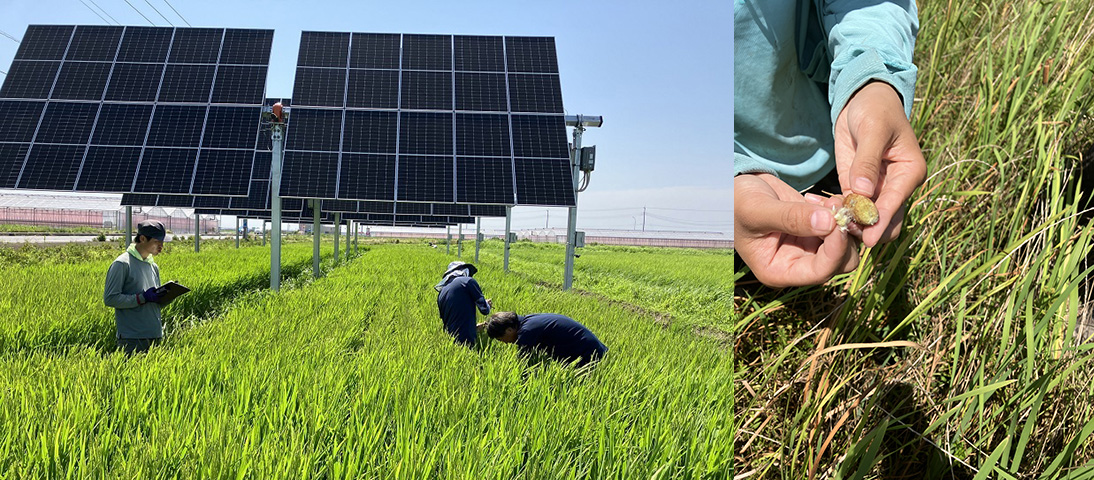
In a demonstration project in Kisarazu City, Idemitsu Kosan confirmed that over a two-year period starting in June 2023, the rice yield and quality were comparable to rice grown in fields that did not have agricultural solar power generation equipment installed.
Approximately 40 times larger than Kisarazu! Large-scale demonstration project to begin in February 2026 in Komatsushima City, Tokushima Prefecture
In the Kisarazu City demonstration, we received advice from farmers who cooperated in the demonstration on how to realize better agricultural solar power generation. For example, agricultural machinery cannot approach near the poles, so dead space is created where rice planting is not possible. This issue can be improved by erecting the poles according to the width of the agricultural machinery being used.
Idemitsu Kosan has begun construction of Japan's first "2MW next-generation agricultural solar power plant" in Komatsushima City, Tokushima Prefecture, utilizing the knowledge gained from the Kisarazu demonstration project to confirm the feasibility of commercializing large-scale next-generation agricultural solar power generation (Japan's first 2MW next-generation agricultural solar power plant to be constructed in Tokushima Prefecture to achieve both agriculture and renewable energy power generation). After completion in February 2026, the company will confirm whether it is possible to achieve both agriculture and power generation in an area approximately 40 times larger than Kisarazu.
Idemitsu Kosan has begun construction of Japan's first "2MW next-generation agricultural solar power plant" in Komatsushima City, Tokushima Prefecture, utilizing the knowledge gained from the Kisarazu demonstration project to confirm the feasibility of commercializing large-scale next-generation agricultural solar power generation (Japan's first 2MW next-generation agricultural solar power plant to be constructed in Tokushima Prefecture to achieve both agriculture and renewable energy power generation). After completion in February 2026, the company will confirm whether it is possible to achieve both agriculture and power generation in an area approximately 40 times larger than Kisarazu.
【reference】
YouTube video: Aiming to achieve a balance between agriculture and power generation through "next-generation agricultural solar power generation"
https://www.youtube.com/watch?v=IX6e-fCpNw4
YouTube video: Aiming to achieve a balance between agriculture and power generation through "next-generation agricultural solar power generation"
https://www.youtube.com/watch?v=IX6e-fCpNw4
Related pages
-
 2023.06.21
Regarding the start of a demonstration project for next-generation agricultural solar power generation, we will contribute to carbon neutrality in farmland through power generation that takes into account the growth of crops.
-
 2023.10.05
Next-generation farming solar power generation system won the 2023 Good Design Award
 return